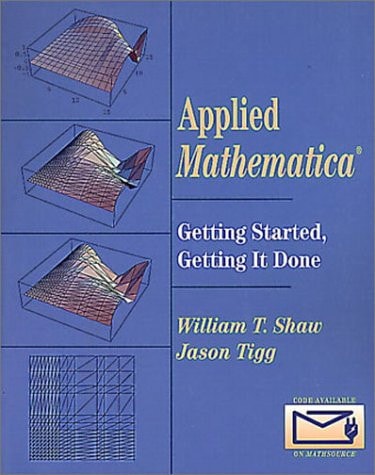
Applied Mathematica: Getting Started, Getting It Done
0
0
As an Amazon Associate and affiliate partner, Menrva Books earns from qualifying purchases. Learn more
Author Description
As an applied scientist you are constantly looking for new and better ways to solve problems. This book shows how Mathematica, the powerful mathematical software system, can be used to solve problems in the applied sciences.Written by two authors who have been teaching Mathematica courses to scientists and engineers for years, this book is a must for anyone who needs to use Mathematica to solve complex problems in the applied sciences. The book tackles complex, practical problems, and shows how to solve them from start to finish.After presenting a "quick start" chapter designed to get you using Mathematica quickly, the authors show how Mathematica can be used as a data analysis and visualization system. Topics in this section include importing information to Mathematica, organizing information, visualizing data in both 2D and 3D, processing information, and exporting results from Mathematica. Next, the authors guide you through programming in Mathematica. Included here are topics such as programming styles, important built-in structures, function definitions, procedural methods, rule-based schemes and iteration, contexts and packages, and increasing efficiency. Also included is a separate section detailing several case studies that explore and apply Mathematica to particular areas. These areas include engineering, finance, environmental modeling, and image processing. The case studies span a wide range of applications - from serious data analysis using robust regression theory and maximum entropy theory, to an enjoyable exploration of the Mandelbrot set using MathLink to create a movie. The book also includes eight pages of full-color images.
Menrva's Summary
THE THESIS
This book investigates how the Mathematica software system can be effectively utilized to solve complex, practical problems within the applied sciences. The authors, Jason Tigg and William T. Shaw, draw upon years of experience teaching Mathematica to scientists and engineers to provide a structured framework for computational problem-solving. By bridging the gap between theoretical mathematics and practical application, the text serves as a guide for professionals and students who need to implement robust analytical solutions in their respective fields.
THE SCOPE MAP
What You Will Find
- A quick-start guide for immediate software proficiency.
- Methodologies for data import, organization, and 2D/3D visualization.
- Comprehensive coverage of programming styles, including procedural and rule-based schemes.
- Applied case studies spanning engineering, finance, environmental modeling, and image processing.
THE AUTHORITY PERSPECTIVE
Experts and practitioners frequently cite this text as a reliable resource for those transitioning from basic software usage to advanced computational modeling. Readers often note that the inclusion of diverse case studies provides a practical context that helps clarify complex programming concepts.
Page Count:
448
Publication Date:
1993-12-31
Publisher:
Addison-Wesley
ISBN-10:
020154217X
ISBN-13:
9780201542172
Data Analysis
Mathematica Computer Program
Mathematics
Programming
Engineering
Computer Science
Reference
Community Tags
Similar Books