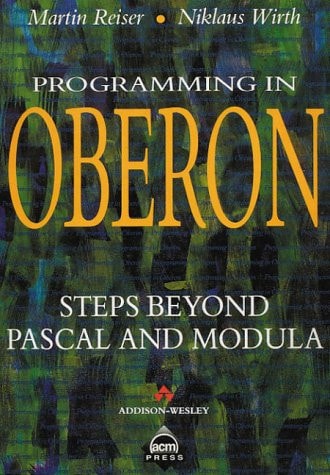
Programming in Oberon: Steps Beyond Pascal and Modula
0
0
As an Amazon Associate and affiliate partner, Menrva Books earns from qualifying purchases. Learn more
Author Description
In 1985 Niklaus Wirth and Jurg Gutknecht embarked on a project to build a new workstation from scratch. The quote from 'Make it as simple as possible, but not simpler' served as a signpost for their approach resulting in a system of exemplary lucidity, efficiency and compactness. Wirth was fascinated by the accuracy and reliability of the Voyager space probe then passing Oberon, one of the moons of Uranus. The project was christened Oberon in its honor. This is the definitive guide to the Oberon language developed as a successor to Pascal and Modula 2. Programming in Oberon * A programming tutorial that demonstrates modern programming concepts; * A complete language reference that explains the syntax and use of Oberon. This unique tutorial will be suitable for students learning Oberon as well as providing a valuable reference for professional programmers. Key features of the book * An early introduction to procedures and modules; * A unifying series of examples of increasing complexity which build up throughout the book towards a complete realistic simulation package; * An explanation of the object-oriented style of programming and its advantages.
Menrva's Summary
THE THESIS
This book investigates the design principles and practical implementation of the Oberon programming language, a successor to Pascal and Modula-2. Authors Martin Reiser and Niklaus Wirth, the latter being the creator of the language, utilize their direct experience in workstation development to present a framework for efficient and compact software design. The text serves as both a pedagogical tutorial and a formal language reference, emphasizing the philosophy of simplicity in system architecture.
THE SCOPE MAP
What You Will Find
- A comprehensive language reference detailing Oberon syntax and semantics.
- A structured tutorial introducing procedures and modules early in the learning process.
- A series of progressive programming examples culminating in a realistic simulation package.
- An analysis of object-oriented programming styles and their practical advantages in software development.
THE AUTHORITY PERSPECTIVE
Experts and computer science educators recognize this text as the definitive primary source for understanding the Oberon language. Readers frequently note the technical precision of the prose, which serves as a foundational reference for those interested in the evolution of structured programming languages.
Page Count:
336
Publication Date:
1992-01-01
Publisher:
Addison-Wesley
ISBN-10:
0201565439
ISBN-13:
9780201565430
Technology
Software Engineering
Computer Science
Programming
Operating systems Computers
Community Tags
Similar Books