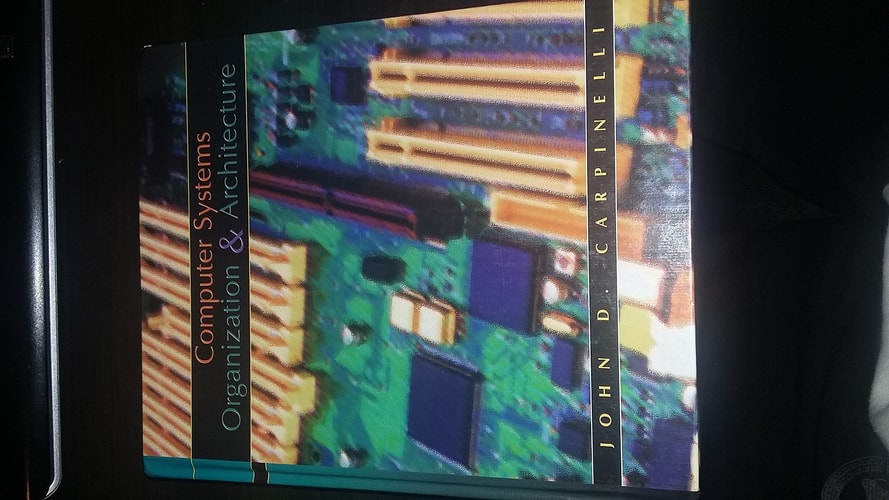
Computer Systems Organization and Architecture
0
0
As an Amazon Associate and affiliate partner, Menrva Books earns from qualifying purchases. Learn more
Author Description
This book provides up-to-date coverage of fundamental concepts for the design of computers and their subsystems. It presents material with a serious but easy-to-understand writing style that makes it accessible to readers without sacrificing important topics. The book emphasizes a finite state machine approach to CPU design, which provides a strong background for reader understanding. It forms a solid basis for readers to draw upon as they study this material and in later engineering and computer science practice. The book also examines the design of computer systems, including such topics as memory hierarchies, input/output processing, interrupts, and direct memory access, as well as advanced architectural aspects of parallel processing. To make the material accessible to beginners, the author has included two running examples of increasing complexity: the Very Simple CPU, which contains four instruction sets and shows very simple CPU design; and the Relatively Simple CPU which contains 16 instruction sets and adds enough complexity to illustrate more advanced concepts. Each chapter features a real-world machine on which the discussed organization and architecture concepts are implemented. This book is designed to teach computer organization/architecture to engineers and computer scientists.
Menrva's Summary
THE THESIS
This text investigates the fundamental principles of computer organization and architecture, providing a structured framework for designing efficient computing systems. John D. Carpinelli utilizes his expertise in engineering education to present complex hardware concepts through a methodical, pedagogical approach. By focusing on finite state machine logic, the author establishes a rigorous foundation for students and practitioners to understand how processors and subsystems interact. The text balances theoretical design with practical implementation to ensure readers can apply these concepts to real-world engineering challenges.
THE SCOPE MAP
What You Will Find
- Finite state machine methodology for CPU design
- Comparative analysis of the Very Simple CPU and Relatively Simple CPU models
- Technical examination of memory hierarchies, interrupts, and direct memory access
- Integration of real-world machine case studies for each architectural concept
THE AUTHORITY PERSPECTIVE
Experts and educators frequently cite this work as a foundational resource for undergraduate computer science and engineering curricula. Readers often note that the inclusion of incremental CPU models provides a clear, logical progression for those new to the complexities of computer hardware design.
Page Count:
608
Publication Date:
2000-10-30
Publisher:
Pearson
ISBN-10:
0201612534
ISBN-13:
9780201612530
Technology
Computer Science
Engineering
Computer Architecture
textbook
Computer Organization