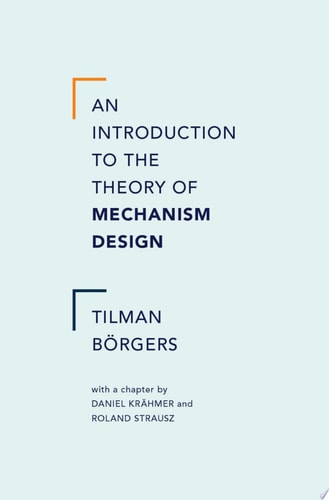
An Introduction to the Theory of Mechanism Design
0
0
As an Amazon Associate and affiliate partner, Menrva Books earns from qualifying purchases. Learn more
Author Description
What is the best way to auction an asset? How should a group of people organize themselves to ensure the best provision of public goods? How should exchanges be organized? In An Introduction to the Theory of Mechanism Design, Tilman Börgers addresses these questions and more through an exploration of the economic theory of mechanism design. Mechanism design is reverse game theory. Whereas game theory takes the rules of the game as a given and makes predictions about the behavior of strategic players, the theory of mechanism design goes a step further and selects the optimal rules of the game. A relatively new economic theory, mechanism design studies the instrument itself as well as the results of the instrument. An Introduction to the Theory of Mechanism Design provides rigorous but accessible explanations of classic results in the theory of mechanism design, such as Myerson's theorem on expected revenue maximizing auctions, Myerson and Satterthwaite's theorem on the impossibility of ex post efficient bilateral trade with asymmetric information, and Gibbard and Satterthwaite's theorem on the non-existence of dominant strategy voting mechanisms. Börgers also provides an examination of the frontiers of current research in the area with an original and unified perspective that will appeal to advanced students of economics.
Menrva's Summary
THE THESIS
How can economic institutions be structured to achieve optimal outcomes when individual participants act strategically? Tilman Börgers, a professor of economics, utilizes the framework of reverse game theory to analyze how designers can select rules that align private incentives with social objectives. The text synthesizes foundational theorems and contemporary research to provide a rigorous mathematical and logical basis for understanding mechanism design.
THE SCOPE MAP
What You Will Find
- Myerson's theorem on expected revenue maximizing auctions
- Myerson and Satterthwaite's theorem on bilateral trade
- Gibbard and Satterthwaite's theorem on voting mechanisms
- Analysis of incentive compatibility and individual rationality
Scope Limits
- The text assumes a high level of mathematical proficiency and prior knowledge of game theory
- It focuses primarily on theoretical models rather than empirical case studies of real-world markets
THE AUTHORITY PERSPECTIVE
Experts and academics recognize this work as a comprehensive and unified introduction to the field of mechanism design. Readers frequently note the technical density of the prose, which is intended for advanced students and researchers in economics.
Page Count:
263
Publication Date:
2015-01-01
Publisher:
Oxford University Press
ISBN-10:
0190244682
ISBN-13:
9780190244682
Economics
Macroeconomic Theory
Game theory
Microeconomics
Academic Textbooks