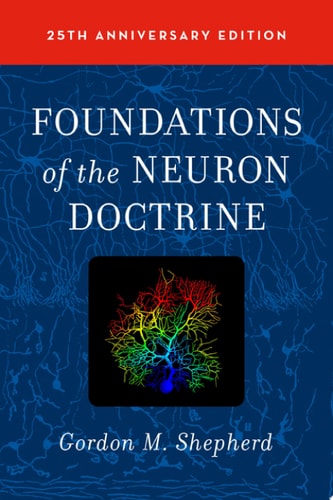
Foundations of the Neuron Doctrine
0
0
As an Amazon Associate and affiliate partner, Menrva Books earns from qualifying purchases. Learn more
Author Description
The Neuron Doctrine, First Formulated In 1891, States That The Brain Is Constructed Of Individual Neurons, Organized Into Functioning Circuits That Mediate Behavior. It Is The Fundamental Principal That Underlies All Of Neuroscience And Clinical Neurology. Foundations Of The Neuron Doctrine Gives An Authoritative Account Of How This Theory Was The Product Of An Explosion Of Histological Studies And Vigorous Debates Near The End Of The Nineteenth Century By An Extraordinary Group Of Scientists, Led By Santiago Ramon Y Cajal Of Spain, Using A Selective Stain Discovered By Camillo Golgi Of Italy. They Were The First To Describe The Distinctive Branching Patterns Of Nerve Cells, Providing Evidence That The Cells Interact As Individual Units To Form Circuits, Opposed However By Golgi, Who Held Out For A View That The Nerve Cells Form Syncytial Networks. Studies In The 1950s Appeared To Confirm The Nerve Cell As An Individual Unit, As Embodied In The Neuron Doctrine, Which Became The Basis For The Rise Of Concepts Of Normal And Disordered Neural Function Since Then. This 25th Anniversary Edition Is Timely. Recent Studies Are Showing A Much Greater Degree Of Complexity In Neuronal Organization, So That The Debate Of Neuron Versus Network Is Again Coming To The Fore In Neuroscience Research. Unique To This Anniversary Edition Is The Inclusion Of Commentaries By Distinguished International Leaders - Marina Bentivoglio, Xavier De Felipe, Sten Grillner, Paolo Mazzarello, Larry Swanson, And Rafael Yuste - On The Continuing Relevance Of The Neuron Doctrine For Modern Studies Of The Brain At All Levels, From Genes And Molecules To Microcircuits, Neural Networks, And Behavior. As This New Wave Of Modern Studies Expands Our Concepts Of Nervous Function As The Basis Of Behavior, Foundations Of The Neuron Doctrine Will Be A Unique Source Providing Conceptual Continuity From Classical Times To The Present And Into The Future. With Commentaries From Marina Bentivoglio Paolo Mazzarello
Menrva's Summary
THE THESIS
How did the neuron doctrine emerge from nineteenth-century histological debates to become the foundational principle of modern neuroscience? Gordon M. Shepherd, a prominent neuroscientist, examines the historical development of the theory that the brain consists of individual neurons organized into functional circuits. The text synthesizes the intense scientific rivalry between Santiago Ramón y Cajal and Camillo Golgi, utilizing historical records and scientific literature to trace the evolution of this concept from its origins to its current status in contemporary brain research.
THE SCOPE MAP
What You Will Find
- Historical analysis of the late nineteenth-century histological studies.
- Detailed accounts of the debate between the neuron theory and the syncytial network theory.
- Modern commentaries from international experts on the current relevance of the doctrine.
- Discussion of the transition from classical anatomical observations to modern molecular and circuit-level neuroscience.
Scope Limits
- The text does not provide a comprehensive clinical manual for neurology.
- It does not cover every minor historical figure involved in early brain research, focusing primarily on the central figures of the debate.
THE AUTHORITY PERSPECTIVE
Experts recognize this work as a definitive historical account of the foundational theory in neuroscience. Readers frequently note the academic density of the prose, which serves as a bridge between historical context and modern research applications.
Page Count:
352
Publication Date:
2015-01-01
Publisher:
Oxford University Press
ISBN-10:
0190259396
ISBN-13:
9780190259396
Neurology
Science History
Neuroscience
Biology
Scientific History
Community Tags
Similar Books