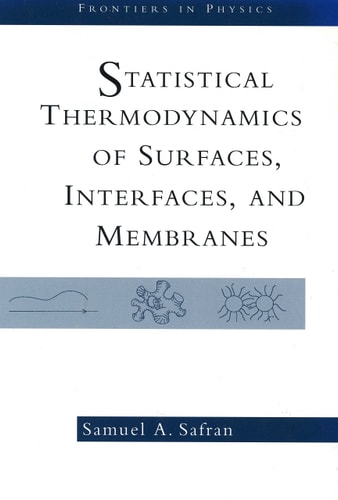
Statistical Thermodynamics of Surfaces, Interfaces and Membranes
0
0
As an Amazon Associate and affiliate partner, Menrva Books earns from qualifying purchases. Learn more
Author Description
Understanding the structural and thermodynamic properties of surfaces, interfaces, and membranes is important for both fundamental and practical reasons. Complex fluids and solids, important in the development of new materials, cannot be designed using trial and error methods due to the multiplicity of components and parameters. While these materials can sometimes be analyzed in terms of microscopic mixtures, it is often conceptually simpler to regard them as dispersions and to focus on the properties of the internal interfaces found in these systems. The basic physics centers on the properties of quasi-two-dimensional systems embedded in the three-dimensional world, thus exhibiting phenomena which do not exist in bulk materials.This approach is the basis behind the theoretical presentation of Statistical Thermodynamics of Surfaces, Interfaces, and Membranes. Focusing on the large-scale properties of these systems, these notes are meant to supplement the usual treatments in books on colloid and interface science. The approach adapted here first presents the traditional approach and then investigates throughout to treat the rich diversity of phenomena investigated in the field of colloid and interface science such as interfacial tension, the roughening transition, wetting, interactions between surfaces, membrane elasticity, and self-assembly. The presentation is that of a set of lecture notes (used in graduate courses taught by the author) including worked examples and further problems. This book is aimed at physicists, physical chemists, chemical engineers, and materials scientists who are interested in the statistical mechanics that underlie the macroscopic, thermodynamic properties of surfaces, interfaces, and membranes.While the primary focus of the book is on the systems important in colloid and interface science, a more general goal is to introduce the reader to several theoretical methods that are useful in applications of statistical mechanics to materials.
Menrva's Summary
THE THESIS
This text investigates the statistical mechanics governing the structural and thermodynamic properties of quasi-two-dimensional systems embedded within three-dimensional materials. Samuel Safran, a physicist with extensive experience in soft matter, utilizes this framework to bridge the gap between microscopic molecular interactions and macroscopic material behavior. The book provides a theoretical foundation for understanding complex fluids, dispersions, and interfaces, moving beyond trial-and-error design methods in materials science.
THE SCOPE MAP
What You Will Find
- Theoretical analysis of interfacial tension, wetting, and the roughening transition.
- Mathematical frameworks for membrane elasticity and self-assembly processes.
- Pedagogical structure including worked examples and problem sets derived from graduate-level coursework.
- Application of statistical mechanics to colloid and interface science for physicists and chemical engineers.
THE AUTHORITY PERSPECTIVE
Experts recognize this work as a standard pedagogical resource for graduate students and researchers in soft matter physics. Readers frequently note the technical density of the prose, which assumes a strong background in statistical mechanics and thermodynamics.
Page Count:
270
Publication Date:
1994-04-20
Publisher:
Addison-Wesley
ISBN-10:
0201626330
ISBN-13:
9780201626339
Materials
Materials Science
Physics
Thermodynamics
Chemistry
Membranes Technology
Surface Chemistry
Statistical mechanics
Statistical thermodynamics
Community Tags
Similar Books