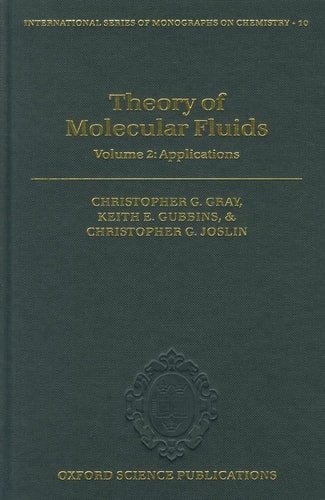
Theory of Molecular Fluids: Volume 2: Applications
0
0
As an Amazon Associate and affiliate partner, Menrva Books earns from qualifying purchases. Learn more
Author Description
Existing texts on the statistical mechanics of liquids treat only spherical molecules. However, nearly all fluids of practical interest are composed of non-spherical molecules that are often dipolar or exhibit other kinds of electrostatic forces. This book describes the statistical mechanical theory of fluids of non-spherical molecules and its application to the calculation of physical properties, and is a sequel to Theory of Molecular Fluids. Volume 1: Fundamentals by C.G. Gray and K.E. Gubbins. The emphasis is on the new phenomena that arise due to the non-spherical nature of the intermolecular forces, such as new phase transitions, structural features and dielectric effects. It contains chapters on the thermodynamic properties of pure and mixed fluids, surface properties, X-ray and neutron diffraction structure factors, dielectric properties and spectroscopic properties. The book is aimed at beginning graduate students and research workers in chemistry, physics, materials science and engineering.
Menrva's Summary
THE THESIS
How can the statistical mechanical theory of fluids be extended to account for non-spherical molecules and their associated electrostatic forces? The authors, experts in chemical physics and molecular modeling, provide a rigorous theoretical framework for calculating the physical properties of complex fluids. By building upon the foundational principles established in their previous volume, they demonstrate how molecular shape and orientation influence macroscopic behavior in pure and mixed systems.
THE SCOPE MAP
What You Will Find
- Thermodynamic properties of pure and mixed non-spherical fluids
- Theoretical models for dielectric and spectroscopic effects
- Analytical methods for calculating surface properties
- Interpretation of X-ray and neutron diffraction structure factors
Scope Limits
- Does not cover basic statistical mechanics for spherical molecules
- Excludes experimental laboratory procedures
THE AUTHORITY PERSPECTIVE
Experts recognize this work as a standard reference for graduate-level research in chemical physics and molecular engineering. Readers frequently note the high level of mathematical rigor and the density of the technical prose required to navigate the complex derivations presented.
Page Count:
752
Publication Date:
2011-01-01
Publisher:
OUP Oxford
ISBN-10:
0191004871
ISBN-13:
9780191004872
Science
Chemistry
Nuclear Physics
Thermodynamics
Physics
Earth Sciences
Statistical mechanics