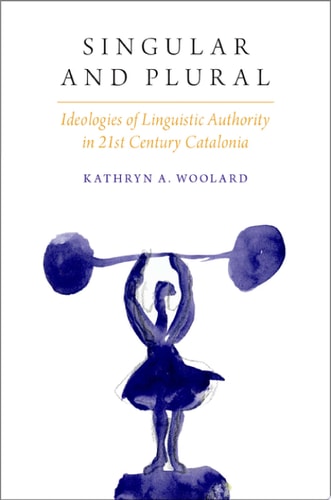
Singular and Plural
0
0
As an Amazon Associate and affiliate partner, Menrva Books earns from qualifying purchases. Learn more
Author Description
A Vibrant And Surprisingly Powerful Civic And Political Movement For An Independent Catalonia Has Brought Renewed Urgency To Questions About What It Means, Personally And Politically, To Speak Or Not To Speak Catalan And To Claim Catalan Identity. In This Book, Kathryn Woolard Develops A Framework For Analyzing Ideologies Of Linguistic Authority And Uses It To Illuminate The Politics Of Language In Spain And Catalonia, Where Catalan Jostles With Castilian For Legitimacy. Longitudinal Research Across Decades Of Political Autonomy Contextualizes This Ethnographic Study Of The Social Meaning Of Catalan In The 21st Century. Part I Lays Out The Ideologies Of Linguistic Authenticity, Anonymity, And Naturalism That Typically Underpin Linguistic Authority In The Modern Western World, And Gives An Overview Of A Shift In The Ideological Grounding Of Linguistic Authority In Contemporary Catalonia. Part Ii Examines Discourses In The Media Surrounding Three Public Linguistic Controversies: An Immigrant President's Linguistic Competence, A Municipal Festival, And An International Book Fair. Part Iii Explores Individuals' Linguistic Practices And Views, Drawing On Classroom Ethnographies And Interviews With Two Generations Of Young People From The Same High School. The Book Argues That There Is An Ongoing Shift At Both Public And Personal Levels Away From The Ethnolinguistic Authenticity That Powered Relations In The Early Transition To Political Autonomy, And Toward New Discourses Of Anonymity, Rooted Cosmopolitanism, And Authenticity Understood As A Project Rather Than A Matter Of Origins And Essence. This Shift Is Reflected In The Current Sovereignty Movement.
Menrva's Summary
THE THESIS
This book investigates how shifting ideologies of linguistic authority shape personal and political identity within the context of the Catalan sovereignty movement. Kathryn A. Woolard, a linguistic anthropologist, utilizes decades of longitudinal ethnographic research to examine the tension between Catalan and Castilian in Spain. She proposes a framework that contrasts traditional notions of ethnolinguistic authenticity with emerging discourses of anonymity and cosmopolitanism to explain contemporary social dynamics.
THE SCOPE MAP
What You Will Find
- A theoretical framework for analyzing linguistic authority, authenticity, and naturalism.
- Analysis of media discourse surrounding specific public linguistic controversies in Catalonia.
- Ethnographic data from classroom observations and interviews with two generations of students.
Scope Limits
- The study focuses primarily on the Catalan-Castilian linguistic landscape and does not provide a comprehensive history of all regional languages in Spain.
- The research emphasizes the transition toward contemporary sovereignty movements rather than providing an exhaustive political history of the region.
THE AUTHORITY PERSPECTIVE
Experts recognize this work as a significant contribution to the field of linguistic anthropology, particularly for its longitudinal approach to language ideology. Scholars frequently note the academic rigor of the prose, making it a valuable resource for those studying the intersection of language, nationalism, and identity.
Page Count:
272
Publication Date:
2016-01-01
Publisher:
Oxford University Press
ISBN-10:
0190258632
ISBN-13:
9780190258634
Identity politics
Language Policy
Catalonia
Anthropology
Spain
Community Tags
Similar Books