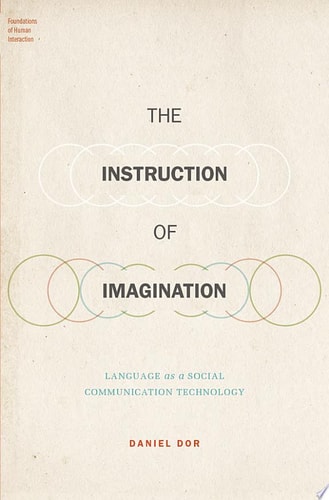
The Instruction of Imagination: Language as a Social Communication Technology
0
0
As an Amazon Associate and affiliate partner, Menrva Books earns from qualifying purchases. Learn more
Author Description
The book suggests a new perspective on the essence of human language. This enormous achievement of our species is best characterized as a communication technology - not unlike the social media on the Net today - that was collectively invented by ancient humans for a very particular communicative function: the instruction of imagination. All other systems of communication in the biological world target the interlocutors' senses; language allows speakers to systematically instruct their interlocutors in the process of imagining the intended meaning - instead of directly experiencing it. This revolutionary function has changed human life forever, and in the book it operates as a unifying concept around which a new general theory of language gradually emerges. Dor identifies a set of fundamental problems in the linguistic sciences - the nature of words, the complexities of syntax, the interface between semantics and pragmatics, the causal relationship between language and thought, language processing, the dialectics of universality and variability, the intricacies of language and power, knowledge of language and its acquisition, the fragility of linguistic communication and the origins and evolution of language - and shows with respect to all of them how the theory provides fresh answers to the problems, resolves persistent difficulties in existing accounts, enhances the significance of empirical and theoretical achievements in the field, and identifies new directions for empirical research. The theory thus opens a new way towards the unification of the linguistic sciences, on both sides of the cognitive-social divide.
Menrva's Summary
THE THESIS
This work investigates the core question of whether human language can be redefined as a social communication technology specifically designed for the instruction of imagination. Dr. Daniel Dor, a researcher in the field of linguistics, proposes a new general theory that positions language as a tool invented by ancient humans to bypass direct sensory experience. By framing language as a technology for mental simulation, the author seeks to unify disparate branches of linguistic science, bridging the gap between cognitive processes and social interaction.
THE SCOPE MAP
What You Will Find
- A theoretical framework defining language as a social communication technology
- Analysis of the relationship between semantics, pragmatics, and syntax
- Examination of the origins and evolution of human linguistic capabilities
- Discussion on the dialectics of linguistic universality and cultural variability
Scope Limits
- The text does not provide a comprehensive history of specific language families
- It avoids detailed neurological mapping of brain regions associated with speech
THE AUTHORITY PERSPECTIVE
Scholars and linguists frequently note the ambitious scope of this text in attempting to unify cognitive and social linguistic theories. Experts highlight the book as a provocative contribution to the debate on language evolution and the functional nature of human communication.
Page Count:
280
Publication Date:
2015-08-14
Publisher:
Oxford University Press
ISBN-10:
0190256621
ISBN-13:
9780190256623
Communication Studies
Evolutionary Biology
Linguistics
Human Interaction
Communication
Philosophy of
Community Tags
Similar Books