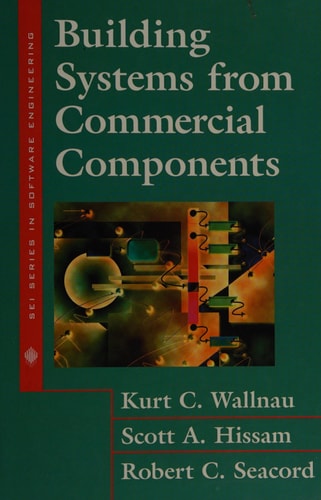
Building Systems from Commercial Components
0
0
As an Amazon Associate and affiliate partner, Menrva Books earns from qualifying purchases. Learn more
Author Description
Commercial software components can dramatically reduce the cost and time required to develop complex business-critical systems. However, integrating them offers stiff challenges that are not well understood by most software practitioners, and there have been many spectacular failures. Now, a team of authors from the Software Engineering Institute draws upon the lessons presented by both the failures and the successes, offering a start-to-finish methodology for integrating commercial components successfully. The authors examine failed integration projects, identifying key lessons and early warning signs, including the failure to account for loss of control over engineering design and production. Drawing upon both successes and failures, they present proven solutions for establishing requirements, evaluating components, creating flexible system designs that incorporate commercial components; and managing multiple concurrent design options linked to external market events and feasibility proofs. They also show how to build "just-in-time" competency with commercial components and integration.
Menrva's Summary
THE THESIS
How can software practitioners successfully integrate commercial off-the-shelf components into complex, business-critical systems while mitigating the risks of project failure? The authors, researchers from the Software Engineering Institute, utilize a comprehensive analysis of both successful and failed integration projects to establish a robust methodology. They argue that the primary challenge lies in the loss of control over engineering design and production, necessitating a shift in how requirements are established and how components are evaluated throughout the development lifecycle.
THE SCOPE MAP
What You Will Find
- A methodology for evaluating commercial components and establishing project requirements.
- Strategies for creating flexible system designs that accommodate external market volatility.
- Analysis of case studies highlighting common failure points in component integration.
- Techniques for managing concurrent design options and building just-in-time technical competency.
THE AUTHORITY PERSPECTIVE
Experts recognize this work as a foundational text for software architects and project managers dealing with commercial integration. Readers frequently note the practical focus on risk management and the clear, systematic approach to handling the complexities of third-party software dependencies.
Page Count:
432
Publication Date:
2001-07-25
Publisher:
Addison-Wesley Professional
ISBN-10:
0201700646
ISBN-13:
9780201700640
Technology
Computer Science
System Design
Systems Architecture
Software Engineering
Community Tags
Similar Books