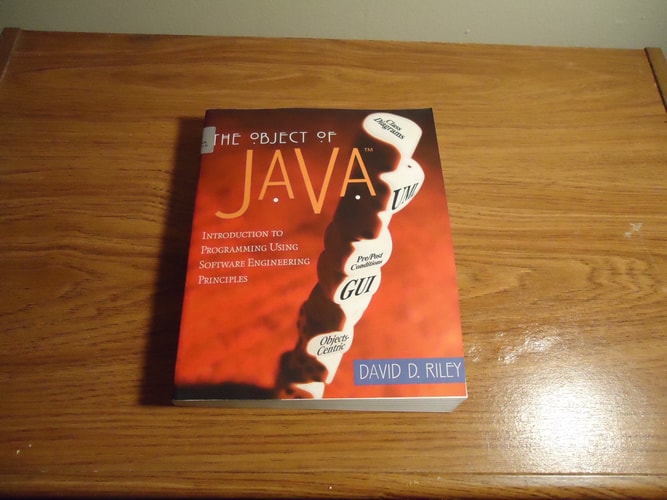
The Object of Java: Introduction to Programming Using Software Engineering Principles
0
0
As an Amazon Associate and affiliate partner, Menrva Books earns from qualifying purchases. Learn more
Author Description
The Object of Java fully embraces the object-oriented paradigm by taking an "objects-centric" approach to presenting problem solving and programming. This book focuses on the skills and discipline of software engineering that are needed for good programming. Since specifications are critical for conveying code behavior in the object-oriented model, discussions of method preconditions and postconditions, and class invariants are used consistently to document examples and to define example classes. The Unified Modeling Language (UML) is used as the specification language. The book also uses the notion of patterns to identify numerous expressions, instructions, algorithms and designs that serve to pattern program segments. Readers begin with four complete chapters focusing on objects, classes and methods. The presentation of primitive data occurs in Chapter 5, ensuring the necessary prior exposure to object declaration, object instantiation, assignment, method calling, parameter passage, class diagrams and object diagrams. In order to accommodate this placement of topics, control structures are covered later than in other books. The book also emphasizes the importance of testing with special sections devoted to ensure that readers develop basic debugging skills, and knowledge of simple path testing and black-box testing. This book is designed for readers without prior programming experience, and is also appropriate for those with knowledge of other languages who are looking for a true object-oriented introduction to Java.
Menrva's Summary
THE THESIS
This text investigates how an object-centric pedagogical approach can effectively teach programming and software engineering principles to beginners. David D. Riley, an experienced educator, utilizes the Java programming language to demonstrate that prioritizing object-oriented concepts over primitive data types fosters better problem-solving habits. By integrating formal specifications and design patterns early in the learning process, the author provides a structured framework for building robust, maintainable code.
THE SCOPE MAP
What You Will Find
- Comprehensive introduction to object-oriented programming using Java.
- Integration of Unified Modeling Language (UML) for class and object specifications.
- Practical instruction on software engineering disciplines including debugging, path testing, and black-box testing.
- A pedagogical sequence that prioritizes object instantiation and method calling before control structures.
THE AUTHORITY PERSPECTIVE
Educators and students frequently cite this text as a foundational resource for those seeking a rigorous, design-focused introduction to Java. Experts highlight the book's consistent use of preconditions, postconditions, and class invariants as a superior method for teaching professional coding standards.
Page Count:
600
Publication Date:
2001-07-07
Publisher:
Addison Wesley
ISBN-10:
0201715856
ISBN-13:
9780201715859
Computer software
Software Engineering
Computer Science
Java
Programming
Education
Community Tags
Similar Books