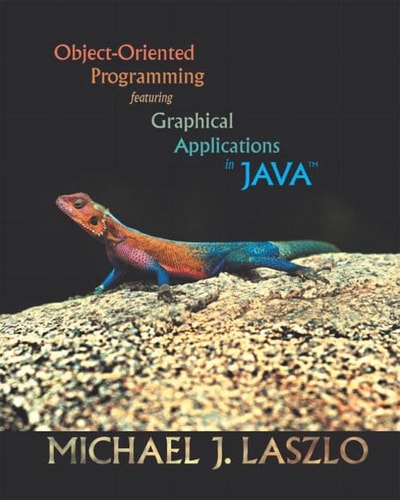
Object-Oriented Programming Featuring Graphical Applications in Java
0
0
As an Amazon Associate and affiliate partner, Menrva Books earns from qualifying purchases. Learn more
Author Description
The goal of this book is to explore the principle ideas of object-oriented programming using the Java programming language. It begins teaching the object-oriented power of Java by relying on textual commands instead of emphasizing the AWT or Swing libraries, providing the reader with a simple, generic introduction to the OO concepts using Java (without the language details getting in the way of the concept presentation). The author provides a thorough introduction to the three fundamental concepts of object-oriented programming: Encapsulation, Inheritance, and Polymorphism. The presentation of OO theory is augmented by interleaved examples that illustrate these concepts. Most of these program examples are 2-D graphics programs that provide an intuitive context for the issues that must be addressed when learning OOP. Additionally, since graphics programming is one of the strengths of the Java development environment, the examples produce interesting and unexpected images that engage and motivate the reader. It contains a concise introduction to using Design Patterns particularly the Template Method, Iterator, and Composite design patterns which relate to the graphics examples in the book and uses UML class diagrams to show the static structure of systems and sequence diagrams to show object interactions. This book is appropriate for readers who are new to object-oriented (but have experience with a non-object-oriented language) and for programmers who want to learn the graphical elements and capabilities of Java.
Menrva's Summary
THE THESIS
This book investigates how the core principles of object-oriented programming can be effectively taught and understood through the practical application of 2-D graphics in Java. Michael L. Laszlo utilizes his academic background to bridge the gap between abstract programming theory and visual implementation. By prioritizing conceptual understanding over complex library syntax, the text provides a structured framework for mastering encapsulation, inheritance, and polymorphism. The author systematically integrates design patterns and modeling techniques to ensure readers can apply these concepts to real-world software development scenarios.
THE SCOPE MAP
What You Will Find
- Fundamental object-oriented concepts including encapsulation, inheritance, and polymorphism.
- Practical implementation of 2-D graphics programming within the Java environment.
- Application of design patterns such as Template Method, Iterator, and Composite.
- Use of UML class diagrams and sequence diagrams for system modeling.
THE AUTHORITY PERSPECTIVE
Experts and educators frequently highlight this text as a balanced resource for programmers transitioning from procedural to object-oriented paradigms. Readers note that the focus on graphical output provides a clear, intuitive context for otherwise abstract software architecture concepts.
Page Count:
468
Publication Date:
2001-01-01
Publisher:
Pearson College Div
ISBN-10:
0201726270
ISBN-13:
9780201726275
Software Engineering
Graphics Programming
Java
Computer Science
Programming
Community Tags
Similar Books