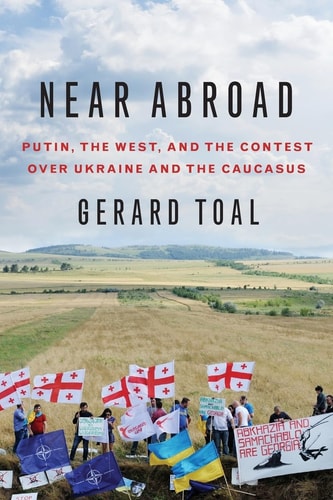
Near Abroad: Putin, the West and the Contest over Ukraine and the Caucasus
0
0
As an Amazon Associate and affiliate partner, Menrva Books earns from qualifying purchases. Learn more
Author Description
Before Russia invaded Ukraine, it invaded Georgia. Both states are part of Russia's "near abroad" - newly independent states that were once part of the Soviet Union and are now Russia's neighbors. While the Russia-Georgia war of 2008 faded from the headlines in the wake of the global recession, the geopolitical contest that created it did not. Six years later, the spectre of a revanchist Russia returned when Putin's forces invaded and annexed the Crimean peninsula, once part of Russia but an internationally recognized part of Ukraine since the Soviet collapse. Crimea's annexation and follow on conflict in eastern Ukraine have generated the greatest geopolitical crisis on the European continent since the end of the Cold War. In Near Abroad, the eminent political geographer Gerard Toal moves beyond the polemical rhetoric that surrounds Russia's interventions in Georgia and Ukraine to study the underlying territorial conflicts and geopolitical struggles. Central to understanding are legacies of the Soviet Union collapse: unresolved territorial issues, weak states and a conflicted geopolitical culture in Russia over the new territorial order. The West's desire to expand NATO contributed to a growing geopolitical contest in Russia's near abroad. This found expression in a 2008 NATO proclamation that Georgia and Ukraine will become members of NATO, a "red line" issue for Russia. The road to invasion and war in Georgia and Ukraine, thereafter, is explained in Near Abroad. Geopolitics is often thought of as a game of chess. Near Abroad provides an account of real life geopolitics, one that emphasizes changing spatial relationships, geopolitical cultures and the power of media images. Rather than being a cold game of deliberation, geopolitics is often driven by emotions and ambitions, by desires for freedom and greatness, by clashing personalities and reckless acts. Not only a penetrating analysis of Russia's relationships with its regional neighbors, Near Abroad also offers
Menrva's Summary
THE THESIS
This book investigates the geopolitical drivers and territorial conflicts that led to Russia's military interventions in Georgia and Ukraine. Gerard Toal, a professor of government and international affairs, utilizes his expertise in political geography to analyze the collapse of the Soviet Union and the subsequent power struggles between Russia and the West. He argues that these conflicts are not merely strategic chess matches, but are deeply influenced by clashing geopolitical cultures, historical legacies, and the expansionist policies of NATO.
THE SCOPE MAP
What You Will Find
- Analysis of the 2008 Russia-Georgia war and the 2014 annexation of Crimea.
- Examination of the concept of the "near abroad" in Russian foreign policy.
- Discussion of the role of media images and emotional narratives in shaping geopolitical conflict.
- Evaluation of NATO expansion as a catalyst for regional instability.
Scope Limits
- The text focuses primarily on the post-Soviet era and does not provide an exhaustive history of the Russian Empire or the entirety of the Cold War.
- It does not offer a comprehensive military history of the conflicts, focusing instead on the political and spatial dimensions.
THE AUTHORITY PERSPECTIVE
Experts in international relations frequently cite this work for its nuanced spatial analysis of post-Soviet conflicts. Readers often note that the text provides a sophisticated alternative to the polarized rhetoric typically found in mainstream media coverage of the region.
Page Count:
408
Publication Date:
2016-01-01
Publisher:
Oxford University Press
ISBN-10:
0190253320
ISBN-13:
9780190253325
History
Caucasus
International relations
Geopolitics
Russia
Ukraine
Public Administration
Community Tags
Similar Books