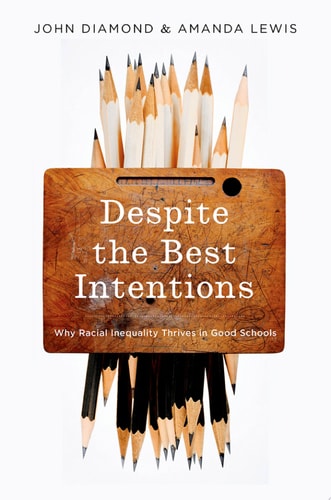
Despite the Best Intentions: How Racial Inequality Thrives in Good Schools
0
0
As an Amazon Associate and affiliate partner, Menrva Books earns from qualifying purchases. Learn more
Author Description
On the surface, Riverview High School looks like the post-racial ideal. Serving an enviably affluent, diverse, and liberal district, the school is well-funded, its teachers are well-trained, and many of its students are high achieving. Yet Riverview has not escaped the same unrelenting question that plagues schools throughout America: why is it that even when all of the circumstances seem right, black and Latino students continue to lag behind their peers? Through five years' worth of interviews and data-gathering at Riverview, John Diamond and Amanda Lewis have created a rich and disturbing portrait of the achievement gap that persists more than fifty years after the formal dismantling of segregation. As students progress from elementary school to middle school to high school, their level of academic achievement increasingly tracks along racial lines, with white and Asian students maintaining higher GPAs and standardized testing scores, taking more advanced classes, and attaining better college admission results than their black and Latino counterparts. Most research to date has focused on the role of poverty, family stability, and other external influences in explaining poor performance at school, especially in urban contexts. Diamond and Lewis instead situate their research in a suburban school, and look at what factors within the school itself could be causing the disparity. Most crucially, they challenge many common explanations of the 'racial achievement gap,' exploring what race actually means in this situation, and why it matters.An in-depth study with far-reaching consequences, Despite the Best Intentions revolutionizes our understanding of both the knotty problem of academic disparities and the larger question of the color line in American society.
Menrva's Summary
THE THESIS
This book investigates why racial achievement gaps persist within affluent, diverse suburban schools despite the presence of significant resources and liberal institutional values. Amanda E. Lewis and John B. Diamond, both established sociologists, utilize five years of ethnographic research and quantitative data from a specific high school district to challenge traditional explanations of academic disparity. They argue that internal school dynamics, rather than solely external socioeconomic factors, play a critical role in maintaining racial inequality.
THE SCOPE MAP
What You Will Find
- Longitudinal data tracking student performance from elementary through high school.
- Analysis of institutional practices, including tracking, teacher expectations, and disciplinary policies.
- Qualitative interviews with students, parents, and faculty members.
Scope Limits
- The study focuses on a single suburban district, limiting its direct generalizability to urban or rural school systems.
- The research does not provide a comprehensive policy manual for immediate school reform.
THE AUTHORITY PERSPECTIVE
Experts in sociology and education frequently cite this work as a critical examination of how institutional culture sustains racial stratification. Readers often note the academic density of the prose, which provides a rigorous, evidence-based look at the complexities of the achievement gap.
Page Count:
272
Publication Date:
2015-01-01
Publisher:
Oxford University Press
ISBN-10:
0190250879
ISBN-13:
9780190250874
Ethnic Studies
Minorities
Race Relations
Education
Sociology
Social Science
Public Policy
Community Tags
Other Editions(2)
Similar Books












Reader Comments
Share Your Thoughts
No comments yet. Be the first to share your thoughts!