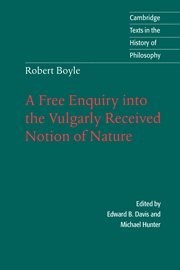
Robert Boyle: A Free Enquiry into the Vulgarly Received Notion of Nature
0
0
As an Amazon Associate and affiliate partner, Menrva Books earns from qualifying purchases. Learn more
Author Description
The main objective of Cambridge Texts in the History of Philosophy is to expand the range, variety, and quality of texts in the history of philosophy which are available in English. The series includes texts by familiar names (such as Descartes and Kant) and also by less well-known authors. Wherever possible, texts are published in complete and unabridged form, and translations are specially commissioned for the series. Each volume contains a critical introduction together with a guide to further reading and any necessary glossaries and textual apparatus. The volumes are designed for student use at undergraduate and postgraduate level, and will be of interest not only to students of philosophy, but also to a wider audience of readers in the history of science, the history of theology, and the history of ideas. In this book, published in 1686, the scientist Robert Boyle (1627-91) attacked prevailing notions of the natural world which depicted 'Nature' as a wise, benevolent and purposeful being. Boyle, one of the leading mechanical philosophers of his day, believed that the world was best understood as a vast, impersonal machine, fashioned by an infinite, personal God. In this cogent treatise, he drew on his scientific findings, his knowledge of contemporary medicine and his deep reflection on theological and philosophical issues, arguing that it was inappropriate both theologically and scientifically to speak of Nature as if it had a mind of its own: instead, the only true efficient causes of things were the properties and powers given to matter by God. As such, A Free Enquiry into the Vulgarly Received Notion of Nature represents one of the subtlest statements concerning the philosophical issues raised by the mechanical philosophy to emerge from the period of the scientific revolution. Book jacket.--Jacket.
Menrva's Summary
THE THESIS
Robert Boyle challenges the prevailing anthropomorphic view of Nature as a sentient entity. In this 1686 treatise, Boyle, a prominent mechanical philosopher, argues against the notion of Nature possessing a mind or purpose. He posits that the world is a machine created by a personal God, and that all phenomena are attributable to the properties and powers God bestowed upon matter. Boyle integrates his scientific findings, medical knowledge, and theological reflections to support his argument, presenting a subtle yet profound philosophical statement on the implications of the mechanical philosophy during the Scientific Revolution.
THE SCOPE MAP
- An examination of the prevailing concept of Nature as a purposeful being.
- Boyle's argument for Nature as an impersonal machine created by God.
- The role of God-given properties and powers as the true efficient causes of phenomena.
- Integration of scientific findings, contemporary medicine, and theological/philosophical reflection.
- A detailed analysis of the philosophical issues raised by the mechanical philosophy.
- Discussion of the scientific revolution's impact on understanding the natural world.
THE AUTHORITY PERSPECTIVE
This work is recognized as a significant contribution to the history of philosophy and science, particularly for its nuanced defense of the mechanical philosophy. Scholars note Boyle's rigorous argumentation, which skillfully blends empirical observation with theological and philosophical reasoning. The text is valued for its clarity and depth in addressing fundamental questions about the nature of reality and the divine role in its creation. It remains a key resource for understanding the intellectual landscape of the Scientific Revolution.
Page Count:
171
Publication Date:
1996-01-01
ISBN-10:
0521561000
ISBN-13:
9780521561006
Philosophy
History
Science
Nature
Non-Fiction
Theology
Community Tags
Similar Books