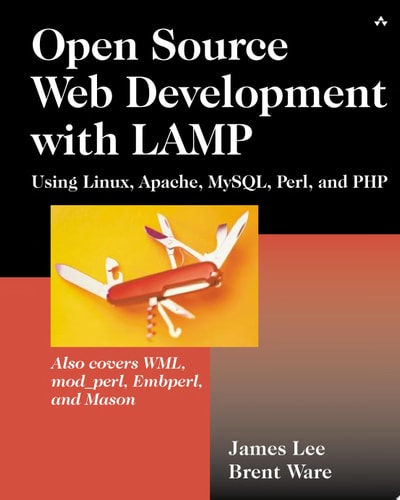
Open Source Development with LAMP: Using Linux, Apache, MySQL, Perl, and PHP
0
0
As an Amazon Associate and affiliate partner, Menrva Books earns from qualifying purchases. Learn more
Author Description
Open source technologies are providing developers with a range of more cost-effective, robust alternatives to commercial software for building dynamic, data-driven, secure Web applications. This practical guide presents a broad survey of LAMP technologies, and shows how these solutions can be implemented efficiently and securely while improving reliability and dramatically cutting costs. The book focuses on the most important core material necessary for the developer to hit the ground running and begin building applications right away, and shows the reader where to go to find comprehensive information on all the topics covered. The book introduces the pillars of open source development, and reviews the current techniques and standards for each. It shows what it is easily possible to do using them, what might be possible with more work, and how to decide which tool is appropriate for what task. In addition to the technologies in the subtitle the book also covers Embperl, mod_perl, Mason, and WML. The authors provide many examples, all of which are active on the companion Web site. Finally, the authors include extensive coverage of the security issues involved.
Menrva's Summary
THE THESIS
This book investigates the practical implementation of the LAMP stack as a robust and cost-effective alternative to commercial software for developing dynamic, data-driven web applications. James Lee provides a technical survey of Linux, Apache, MySQL, Perl, and PHP, offering a framework for developers to select the appropriate tools for specific project requirements. The text emphasizes security, reliability, and efficiency, serving as a foundational resource for engineers transitioning to open-source development environments.
THE SCOPE MAP
What You Will Find
- Comprehensive overview of the LAMP stack architecture and its core components.
- Technical integration strategies for Linux, Apache, MySQL, Perl, and PHP.
- Coverage of auxiliary technologies including Embperl, mod_perl, Mason, and WML.
- Practical security protocols and best practices for web application deployment.
THE AUTHORITY PERSPECTIVE
Experts recognize this work as a practical, hands-on resource for developers seeking to implement open-source solutions in professional environments. Readers frequently note the balance between high-level architectural overview and the inclusion of functional code examples for immediate application.
Page Count:
494
Publication Date:
2002-12-17
Publisher:
Pearson Technology Group
ISBN-10:
020177061X
ISBN-13:
9780201770612
Open Source
Linux
Software Engineering
Programming
Technology
Computer software
Community Tags
Similar Books