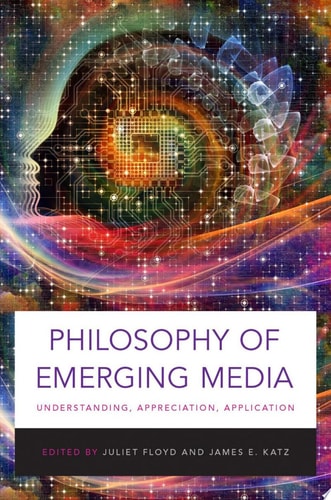
Philosophy of Emerging Media: Understanding, Appreciation, Application
0
0
As an Amazon Associate and affiliate partner, Menrva Books earns from qualifying purchases. Learn more
Author Description
The term "emerging media" responds to the "big data" now available as a result of the larger role digital media play in everyday life, as well as the notion of "emergence" that has grown across the architecture of science and technology over the last two decades with increasing imbrication. The permeation of everyday life by emerging media is evident, ubiquitous, and destined to accelerate. No longer are images, institutions, social networks, thoughts, acts of communication, emotions and speech-the "media" by means of which we express ourselves in daily life-linked to clearly demarcated, stable entities and contexts. Instead, the loci of meaning within which these occur shift and evolve quickly, emerging in far-reaching ways we are only beginning to learn and bring about.This volume's purpose is to develop, broaden and spark future philosophical discussion of emerging media and their ways of shaping and reshaping the habitus within which everyday lives are to be understood. Drawing from the history of philosophy ideas of influential thinkers in the past, intellectual path makers on the contemporary scene offer new philosophical perspectives, laying the groundwork for future work in philosophy and in media studies. On diverse topics such as identity, agency, reality, mentality, time, aesthetics, representation, consciousness, materiality, emergence, and human nature, the questions addressed here consider the extent to which philosophy should or should not take us to be facing a fundamental transformation.
Menrva's Summary
THE THESIS
This volume investigates the philosophical implications of emerging digital media and how these technologies fundamentally reshape human experience, identity, and social structures. The authors, James E. Katz and Juliet Floyd, curate a collection of essays from contemporary thinkers who synthesize historical philosophical frameworks with modern technological developments. The text argues that the rapid evolution of digital environments necessitates a new philosophical vocabulary to understand the shifting nature of human agency and reality.
THE SCOPE MAP
What You Will Find
- Philosophical analysis of identity, agency, and consciousness in digital spaces
- Theoretical frameworks for understanding the concept of emergence in technology
- Historical philosophical perspectives applied to modern media studies
- Explorations of materiality, aesthetics, and time within digital contexts
Scope Limits
- The text does not provide a technical manual for media development or software engineering
- It does not offer a comprehensive history of all digital media platforms
THE AUTHORITY PERSPECTIVE
Experts and scholars in media studies identify this volume as a significant contribution to the intersection of philosophy and digital technology. Readers frequently note the academic density of the prose, which is intended for researchers and students engaged in advanced theoretical discourse.
Page Count:
466
Publication Date:
2015-12-22
Publisher:
Oxford University Press
ISBN-10:
0190260742
ISBN-13:
9780190260743
Philosophy
Mass media
Media Studies
Digital Media
Sociology
Technology
Communication
Community Tags
Similar Books