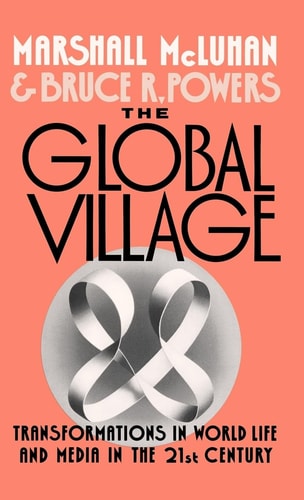
The Global Village: Transformations in World Life and Media in the 21st Century
0
0
As an Amazon Associate and affiliate partner, Menrva Books earns from qualifying purchases. Learn more
Author Description
Extending the visionary early work of the late Marshall McLuhan, The Global Village, one of his last collaborative efforts, applies that vision to today's worldwide, integrated electronic network.When McLuhan's groundbreaking Understanding Media was published in 1964, the media as we know it today did not exist. But McLuhan's argument, that the technological extensions of human consciousness were racing ahead of our ability to understand their consequences, has never been more compelling. And if the medium is the message, as McLuhan maintained, then the message is becoming almost impossible to decipher.In The Global Village, McLuhan and co-author Bruce R. Powers propose a detailed conceptual framework in terms of which the technological advances of the past two decades may be understood. At the heart of their theory is the argument that today's users of technology are caught between two very different ways of perceiving the world. On the one hand there is what they refer to as Visual Space--the linear, quantitative mode of perception that is characteristic of the Western world; on the other hand there is Acoustic Space--the holistic, qualitative reasoning of the East. The medium of print, the authors argue, fosters and preserves the perception of Visual Space; but, like television, the technologies of the data base, the communications satellite, and the global media network are pushing their users towards the more dynamic, "many-centered" orientation of Acoustic Space.The authors warn, however, that this movement towards Acoustic Space may not go smoothly. Indeed, McLuhan and Powers argue that with the advent of the global village--the result of worldwide communications--these two worldviews "are slamming into each other at the speed of light," asserting that "the key to peace is to understand both these systems simultaneously."Employing McLuhan's concept of the Tetrad--a device for predicting the changes wrought by new technologies--the authors analyze this collisi
Menrva's Summary
THE THESIS
How do the rapidly evolving electronic media networks of the 21st century fundamentally alter human perception and global social structures? Marshall McLuhan and Bruce R. Powers apply McLuhan's established media theory to the modern era, arguing that humanity is currently transitioning from a linear, Western-centric mode of thought toward a holistic, global consciousness. The authors utilize the concept of the Tetrad to analyze how technological advancements force a collision between traditional visual perception and a new, many-centered acoustic reality.
THE SCOPE MAP
What You Will Find
- A comparative analysis of Visual Space versus Acoustic Space as modes of human cognition.
- The application of the Tetrad framework to predict the societal impacts of new communication technologies.
- Examination of how global electronic networks and satellite communications dissolve traditional geographic and cultural boundaries.
- Theoretical exploration of the tension between print-based logic and the instantaneous nature of electronic media.
THE AUTHORITY PERSPECTIVE
Experts recognize this work as a critical extension of McLuhan's earlier theories, providing a necessary bridge between his mid-century insights and the digital age. Readers frequently note the dense, aphoristic style of the prose, which requires careful attention to grasp the authors' complex conceptual frameworks.
Page Count:
240
Publication Date:
1989-06-01
Publisher:
Oxford University Press
ISBN-10:
019505444X
ISBN-13:
9780195054446
Philosophy
Communication
Mass media
Sociology
Media Studies
Technology
Community Tags
Similar Books





Reader Comments
Share Your Thoughts
No comments yet. Be the first to share your thoughts!