Algorithms in C++
0
0
As an Amazon Associate and affiliate partner, Menrva Books earns from qualifying purchases. Learn more
Author Description
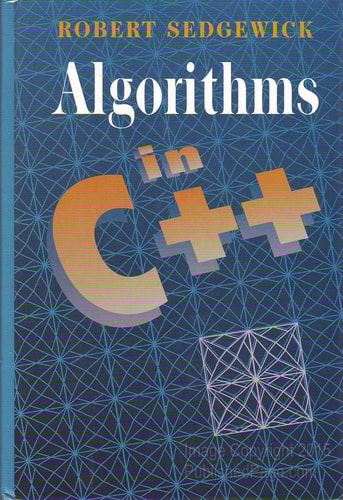
The latest addition to Robert Sedgewick's popular series of books carries his comprehensive collection of algorithms into an object-oriented programming (OOP) environment with implementation in the C++ programming language. These algorithms cover a broad range of fundamental and more advanced methods: sorting, searching, string-processing, geometric, graph, and mathematical algorithms. The algorithms are all expressed in terms of concise implementations in C++, so that readers can both appreciate their basic properties and test them on real applications. The treatment of analysis of algorithms is carefully developed. When appropriate, analytic results are discussed to illustrate why certain algorithms are preferred, and in some cases, the relationship of the practical algorithms being discussed to purely theoretical results is also described. The ultimate aim of the book is to improve programming practice, whatever the environment, whatever the implementation language. Sedgewick describes the basic methods to be considered in every case. Features hundreds of detailed, innovative figures clearly demonstrate how important algorithms work. Throughout the book, properties sections encapsulate specific information on the performance characteristics of algorithms. Six chapters discuss fundamental concepts, including a brief introduction to data structures. Algorithms in C++ provides readers with the tools to implement, run, and debug useful algorithms with confidence. This book is a helpful guide for users engaged in the transition to or experimentation with OOP and/or the C++ language. It may be used for self study, or as a reference for developers or computer systems or applications programs.
Menrva's Summary
THE THESIS
This text investigates the implementation and analysis of fundamental and advanced algorithms within an object-oriented programming framework using C++. Robert Sedgewick, a prominent computer scientist, leverages his extensive academic background to bridge the gap between theoretical algorithmic efficiency and practical software development. The book provides a rigorous methodology for evaluating performance characteristics, ensuring that developers understand the mathematical underpinnings of the code they implement in real-world applications.
THE SCOPE MAP
What You Will Find
- Comprehensive coverage of sorting, searching, string-processing, geometric, graph, and mathematical algorithms.
- Detailed analysis of algorithmic performance characteristics and complexity.
- Implementation-focused C++ code examples designed for testing and experimentation.
- Visual aids and figures illustrating the mechanics of complex algorithmic operations.
THE AUTHORITY PERSPECTIVE
Experts and educators frequently cite this work as a foundational resource for understanding the intersection of data structures and object-oriented design. Readers often note the technical density of the prose, which serves as a reliable reference for both students and professional software engineers.
Page Count:
1312
Publication Date:
2012-01-30
Publisher:
Pearson P T R
ISBN-10:
0201849380
ISBN-13:
9780201849387
Computer Algorithms
Algorithms
Reference
Computer Science
Programming
C++
Community Tags
Similar Books