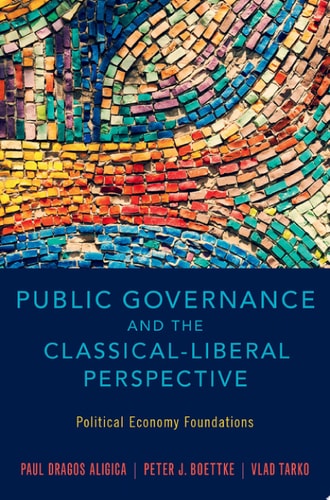
Public Governance and the Classical-Liberal Perspective
0
0
As an Amazon Associate and affiliate partner, Menrva Books earns from qualifying purchases. Learn more
Author Description
Classical Liberalism Entails Not Only A Theory About The Scope Of Government And Its Relationship With The Market But Also A Distinct View About How Government Should Operate Within Its Proper Domain Of Public Choices In Non-market Settings. Building On The Political Economy Principles Underpinning The Works Of Diverse Authors Such As Friedrich Hayek, James Buchanan And Vincent And Elinor Ostrom, This Book Challenges The Technocratic-epistocratic Perspective In Which Social Goals Are Defined By An Aggregated Social Function And Experts Simply Provide The Means To Attain Them. The Authors Argue That Individualism, Freedom Of Choice, And Freedom Of Association Have Deep Implications On How We Design, Manage And Assess Our Public Governance Arrangements. The Book Examines The Knowledge And Incentive Problems Associated With Bureaucratic Public Administration While Contrasting It With Democratic Governance. Aligica, Boettke, And Tarko Argue That The Focus Should Be On The Diversity Of Opinions In Any Society Regarding What Should Be Done And On The Design Of Democratic And Polycentric Institutions Capable Of Limiting Social Conflicts And Satisfying The Preferences Of As Many People As Possible. They Thus Fill A Large Gap In The Literature, The Public Discourse, And The Ways Decision Makers Understand The Nature And Administration Of The Public Sector.
Menrva's Summary
THE THESIS
This book investigates how classical liberal principles can be applied to the design and operation of public governance institutions to move beyond technocratic models. The authors, Peter J. Boettke, Paul Dragos Aligica, and Vlad Tarko, utilize the political economy frameworks established by thinkers such as Friedrich Hayek, James Buchanan, and the Ostroms. They argue that public administration must account for individual freedom and incentive structures rather than relying on top-down expert-led social engineering.
THE SCOPE MAP
What You Will Find
- Analysis of knowledge and incentive problems in bureaucratic systems
- Comparison between technocratic-epistocratic models and democratic governance
- Theoretical application of polycentric institutional design
- Synthesis of classical liberal political economy
Scope Limits
- Does not provide a manual for specific legislative drafting
- Does not focus on private sector market mechanics independent of public choice
THE AUTHORITY PERSPECTIVE
Experts identify this work as a significant contribution to the intersection of public choice theory and institutional economics. Readers frequently note the academic density of the prose, which is intended for scholars and students of political economy.
Page Count:
224
Publication Date:
2019-01-01
Publisher:
Oxford University Press
ISBN-10:
0190267046
ISBN-13:
9780190267049
Economics
Public Policy
Community Tags
Similar Books