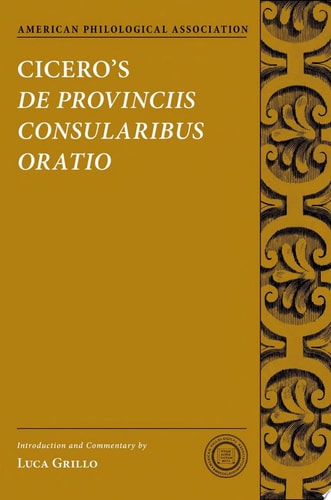
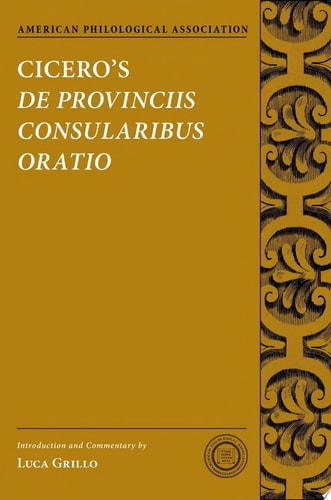
Cicero's De Provinciis Consularibus Oratio
0
0
As an Amazon Associate and affiliate partner, Menrva Books earns from qualifying purchases. Learn more
Author Description
Perhaps no other single Roman speech exemplifies the connection between oratory, politics and imperialism better than Cicero's De Provinciis Consularibus, pronounced to the senate in 56 BC. Cicero puts his talents at the service of the powerful "triumviri" (Caesar, Crassus and Pompey), whose aims he advances by appealing to the senators' imperialistic and chauvinistic ideology. This oration, then, yields precious insights into several areas of late republican life: international relations between Rome and the provinces (Gaul, Macedonia and Judaea); the senators' view on governors, publicani (tax-farmers) and foreigners; the dirty mechanics of high politics in the 50s, driven by lust for domination and money; and Cicero's own role in that political choreography. This speech also exemplifies the exceptional range of Cicero's oratory: the invective against Piso and Gabinius calls for biting irony, the praise of Caesar displays high rhetoric, the rejection of other senators' recommendations is a tour de force of logical and sophisticated argument, and Cicero's justification for his own conduct is embedded in the self-fashioning narrative which is typical of his post reditum speeches. This new commentary includes an updated introduction, which provides the readers with a historical, rhetorical and stylistic background to appreciate the complexities of Cicero's oration, as well as indexes and maps.
Menrva's Summary
THE THESIS
This work investigates how Cicero's 56 BC speech, De Provinciis Consularibus, serves as a primary lens for understanding the intersection of Roman imperial ideology, political maneuvering, and oratorical strategy during the late Republic. Luca Grillo, a scholar of classical rhetoric, provides a comprehensive analysis of the speech's historical context and stylistic composition. By examining the text, Grillo demonstrates how Cicero utilized specific rhetorical techniques to align himself with the triumviri while navigating the complex power dynamics of the Roman Senate.
THE SCOPE MAP
What You Will Find
- Historical analysis of Roman international relations regarding Gaul, Macedonia, and Judaea
- Examination of the roles of governors and publicani in provincial administration
- Detailed breakdown of Ciceronian rhetorical devices including invective and high rhetoric
- Contextual background on the political climate of the 50s BC
Scope Limits
- The text focuses primarily on the specific oration rather than a general history of the late Republic
- It does not provide a comprehensive biography of Cicero beyond his political activities in 56 BC
THE AUTHORITY PERSPECTIVE
Scholars and students of classical rhetoric frequently cite this commentary as a vital resource for understanding the nuances of Ciceronian political discourse. Experts highlight the text for its ability to bridge the gap between historical analysis and linguistic precision, making it a standard reference for those studying Roman oratory.
Page Count:
367
Publication Date:
2015-01-01
Publisher:
Oxford University Press
ISBN-10:
0190266376
ISBN-13:
9780190266370
History
Biography
Ancient History
Oratory
Ancient - Rome
Community Tags
Other Editions(2)
Similar Books