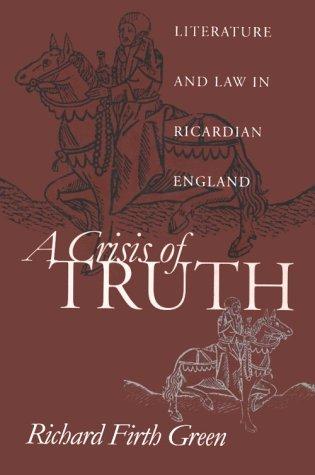
A Crisis of Truth
0
0
As an Amazon Associate and affiliate partner, Menrva Books earns from qualifying purchases. Learn more
Author Description
In the late fourteenth century, the complex Middle English word trouthe, which had earlier meant something like "integrity" or "dependability," began to take on its modern sense of "conformity to fact." At the same time, the meaning of its antonym, tresoun, began to move from "personal betrayal" to "a crime against the state." In A Crisis of Truth, Richard Firth Green contends that these alterations in meaning were closely linked to a growing emphasis on the written over the spoken and to the simultaneous reshaping of legal thought and practice. Green's study presents law and literature as two parallel discourses which have, at times, converged and influenced each other. Ranging deeply and widely over a huge body of legal and literary materials, from Anglo-Saxon England to twentieth-century Africa, it will provide a rich source of information for literary, legal, and historical scholars.
Menrva's Summary
THE THESIS
The late fourteenth century witnessed a significant shift in the meaning of the English word 'trouthe' from 'integrity' to 'conformity to fact,' a change Richard Firth Green argues is intrinsically linked to the evolving emphasis on written records and legal practices. Green's study explores how this semantic evolution, alongside the transformation of 'tresoun' from personal betrayal to treason, reflects a broader reshaping of legal thought and a growing reliance on the written word over oral tradition. The book examines the interplay between law and literature as parallel discourses that have historically converged and influenced one another. This analysis spans a vast array of legal and literary materials, demonstrating a wide chronological and geographical scope.
THE SCOPE MAP
- Analysis of the semantic shift in the word 'trouthe' in the late fourteenth century.
- Examination of the changing meaning of 'tresoun' from personal betrayal to treason.
- Exploration of the link between these linguistic changes and the rise of written records.
- Investigation into the reshaping of legal thought and practice during this period.
- Discussion of law and literature as converging and influencing discourses.
- Coverage of materials from Anglo-Saxon England to twentieth-century Africa.
- Rich source of information for literary, legal, and historical scholars.
THE AUTHORITY PERSPECTIVE
This book is recognized as a significant scholarly contribution, offering a deep and wide-ranging analysis of linguistic and legal history. Scholars in literary, legal, and historical fields are likely to find its extensive research and interdisciplinary approach valuable. The book's strength lies in its detailed examination of how language, law, and societal practices evolved in tandem. Its broad scope and the intricate connections it draws between seemingly disparate historical periods and regions underscore its academic merit.
Page Count:
496
Publication Date:
1999-01-01
ISBN-10:
0812234634
History
Non-Fiction
Law
Linguistics
Literature
Community Tags
Similar Books