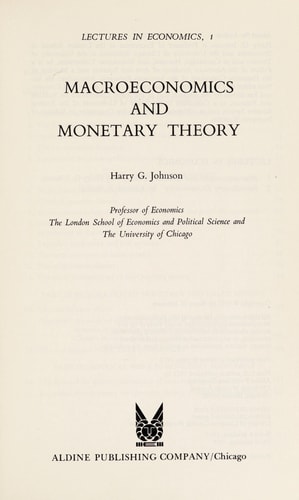
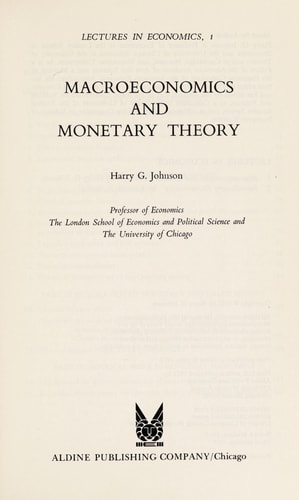
Macroeconomics and Monetary Theory
0
0
As an Amazon Associate and affiliate partner, Menrva Books earns from qualifying purchases. Learn more
Author Description
Macroeconomics is an outgrowth from the main stream of classical monetary theory following Keynes. Keynes changed the emphasis from determination of the level of money prices to determination of the level of output and employment. He also changed the key relationship from demand and supply of money as determining the price level to the relationship between consumption expenditure and income, in conjunction with private investment expenditure, as determining the level of output and therefore employment demanded. The income multiplier replaced the velocity of circulation as the key concept of monetary theory. The tendency of the past twenty-five years has been to reintegrate Keynesian and classical monetary theory into one general system of analysis. Moreover, as inflation has succeeded mass unemployment as a major policy problem, interest in classical monetary theory has revived, while Keynesians have increasingly' emphasized the monetary aspects of Keynesian theory. The proper contemporary distinction is not between two separate branches of economic theory, but between two areas of application or contexts of the theory of rational maximizing behavior. In the one (the microeconomic) context, it is assumed either that the overall workings of the economic system can be disregarded, or that the macroeconomic relationships are in full general equilibrium. In the other (the macroeconomic) context, it is assumed that the maximizing decisions of individual economic units (firms and households) will not necessarily add up to a macroeconomic equilibrium, but will produce a disequilibrium situation that will in the course of time produce changes in the individual decisions.
Menrva's Summary
THE THESIS
This text investigates the historical and theoretical synthesis of Keynesian economics with classical monetary theory to establish a unified framework for understanding modern economic systems. Harry Gordon Johnson, a prominent economist, utilizes his expertise in international trade and monetary policy to analyze how the shift from price-level determination to output and employment analysis redefined the field. He argues that the contemporary economic landscape requires a reintegration of these two schools of thought to address modern policy challenges like inflation. The work provides a rigorous examination of how individual rational maximizing behavior functions within both microeconomic and macroeconomic contexts.
THE SCOPE MAP
What You Will Find
- Historical evolution of monetary theory from classical models to the Keynesian revolution.
- Comparative analysis of the income multiplier versus the velocity of circulation.
- Theoretical framework for reconciling individual unit decisions with macroeconomic disequilibrium.
- Examination of the shift in policy focus from mass unemployment to inflationary pressures.
THE AUTHORITY PERSPECTIVE
Experts recognize this work as a foundational lecture series that bridges the gap between mid-20th-century economic schools of thought. Readers frequently note the academic density of the prose, which serves as a rigorous primer for students and practitioners of economic theory.
Page Count:
214
Publication Date:
1972-01-01
Publisher:
Aldine Pub. Co
ISBN-10:
0202060543
ISBN-13:
9780202060545
Economics
Keynesian Economics
Monetary Theory
Macroeconomics
Community Tags
Other Editions(3)

Similar Books



Reader Comments
Share Your Thoughts
No comments yet. Be the first to share your thoughts!