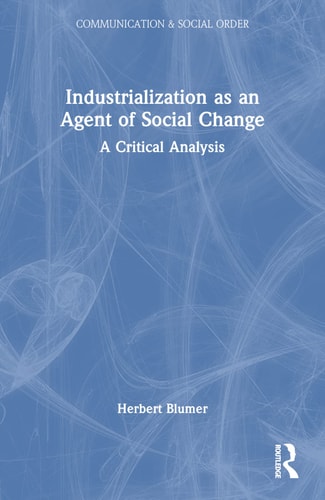
Industrialization as an Agent of Social Change: A Critical Analysis
0
0
As an Amazon Associate and affiliate partner, Menrva Books earns from qualifying purchases. Learn more
Author Description
Herbert Blumer wrote continuously and voluminously, and consequently left a vast array of unpublished work at the time of his death in 1987. This posthumously published volume testifies further to his perceptive analysis of large-scale social organizations and elegant application of symbolic interactionist principles.Blumer's focus on the processual nature of social life and on the significance of the communicative interpretation of social contexts is manifest in his theory of industrialization and social change. His theory entails three major points: industrialization must be seen in processual terms, and the industrialization process is different for different historical periods; the consequences of industrialization are a function of the interpretive nature of human action and resembles a neutral framework within which groups interpret the meaning of industrial relations, and the industrial sector must be viewed in terms of power relations; industrial societies contain inherently conflicting interests.The editors' introductory essay outlines Blumer's metatheoretical stance (symbolic interactionism) and its emphasis on the adjustive character of social life. It places Blumer's theory in the context of contemporary macro theory, including world systems theory, resource dependence theory, and modernization theory.
Menrva's Summary
THE THESIS
This volume investigates how industrialization functions as a primary driver of social transformation through the lens of symbolic interactionism. Herbert Blumer, a prominent sociologist, utilizes his expertise in social organization to argue that industrialization is not a static event but a dynamic, processual phenomenon. He posits that the consequences of industrial development are mediated by human interpretation and power dynamics, challenging deterministic views of modernization. The text synthesizes his posthumous writings to provide a framework for understanding how groups navigate conflicting interests within industrial societies.
THE SCOPE MAP
What You Will Find
- A detailed application of symbolic interactionist principles to macro-level social structures.
- A tripartite theory of industrialization focusing on process, interpretation, and power relations.
- Comparative analysis situating Blumer's work against world systems, resource dependence, and modernization theories.
- An editorial introduction framing Blumer's metatheoretical stance within contemporary sociological discourse.
THE AUTHORITY PERSPECTIVE
Scholars recognize this work as a significant contribution to the understanding of Blumer's later theoretical developments. Readers frequently note the academic density of the prose, which serves as a foundational text for those studying the intersection of communication and social order.
Page Count:
196
Publication Date:
1990-12-31
Publisher:
Routledge
ISBN-10:
0202304116
ISBN-13:
9780202304113
Social Theory
Social change
Sociology
Symbolic interactionism