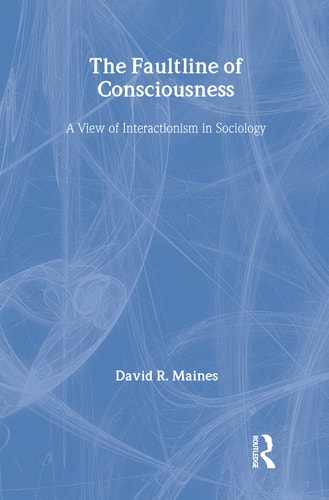
The Faultline of Consciousness: A View of Interactionism in Sociology
0
0
As an Amazon Associate and affiliate partner, Menrva Books earns from qualifying purchases. Learn more
Author Description
In this compendium of related and cross-referential essays, David R. Maines draws from pragmatist/symbolic interactionist assumptions to formulate a consistent new view of the entire field of sociology. Suitable for courses in social theory, qualitative methods, social psychology, and narrative inquiry, this volume will change the way the general public looks at interpretive sociology.This book is organized as an expression of the centrality of interactionism to general sociology. Each chapter is designed to articulate this view of the field. Symbolic interactionism, the way Maines has come to understand and use it, is essentially the concerted application of pragmatist principles of philosophy to social inquiry.There are four basic elements to this characterization. First, people transform themselves: people are self-aware beings who reflexively form their conduct and thus are capable of adjusting their lines of action and creating new ones. Second, people transform their social worlds: human action takes place in contexts of situations and social worlds. People can modify the social matrices in which they act, and thus people are agents of change. Third, people engage in social dialogue: communication is generic and is at the heart of both stability and change. A fourth element is that people respond to and deal with their transformations. Humans construct situations and societies; they establish social structures and cultures. These are the consequences of human action and, once formed, they reflexively function to direct and channel conduct.Maines argues that when people do things together they can create enduring group formations, such as divisions of labor, rules for inheritance, wage-labor relations, or ideologies. These are instances of group characteristics that influence human conduct and indeed are not reducible to the traits of individuals making up the group or society.
Menrva's Summary
THE THESIS
This work investigates the core question of how symbolic interactionism can serve as a unifying framework for the entire field of sociology. David R. Maines, a scholar grounded in pragmatist and interactionist traditions, synthesizes a series of essays to argue that social structures are not static entities but are instead the reflexive products of human agency and communication. By applying pragmatist philosophical principles to social inquiry, Maines establishes a model where individuals act as active agents who simultaneously construct and are constrained by the social worlds they inhabit.
THE SCOPE MAP
What You Will Find
- A comprehensive re-evaluation of symbolic interactionism as a central pillar of general sociology.
- A four-part framework detailing human self-transformation, social world modification, the role of social dialogue, and the reflexive nature of social structures.
- Analysis of how collective human action leads to enduring group formations such as divisions of labor and ideologies.
- Methodological applications suitable for social theory, qualitative research, and narrative inquiry.
THE AUTHORITY PERSPECTIVE
Scholars and students of social theory frequently cite this text as a rigorous application of pragmatist principles to contemporary sociological problems. Experts highlight the book as a useful resource for those seeking to understand the intersection of individual agency and structural stability within the field of interpretive sociology.
Page Count:
306
Publication Date:
2001-01-01
Publisher:
Aldine
ISBN-10:
0202306453
ISBN-13:
9780202306452
Philosophy
Sociology
Social Theory
Symbolic interactionism
Community Tags
Other Editions(2)
Similar Books








Reader Comments
Share Your Thoughts
No comments yet. Be the first to share your thoughts!