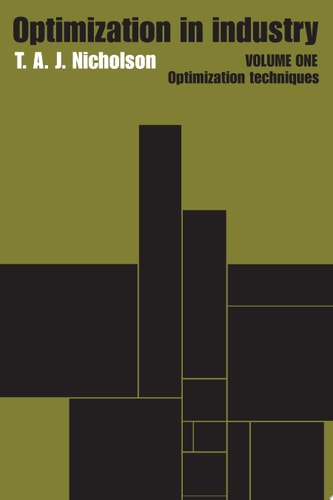
Optimization in Industry: Volume 1, Optimization Techniques
0
0
As an Amazon Associate and affiliate partner, Menrva Books earns from qualifying purchases. Learn more
Author Description
As optimization techniques have developed, a gap has arisen between the people devising the methods and the people who actually need to use them. Research into methods is necessarily long-term and located usually in academic establishments; whereas the application of an optimization technique, normally in an industrial environment, has to be justified financially in the short term. The gap is probably inevitable; but there is no need for textbooks to reflect it. Teaching of optimization techniques separately from their connection with applications is pointless. This book gives a detailed exposition of the techniques.In this first volume, T. A. J. Nicholson demonstrates the full range of techniques available to the practitioner for the solution of varying problems. For each technique, the background reasoning behind its development is explained in simple terms; where helpful it is supported by a geometrical argument; and the iterative algorithm for finding the optimum is defined clearly. These steps enable the reader not only to see plainly what is happening in the method but also to reach a level of understanding necessary to write computer programs for optimization techniques.Problems are tackled in the same way--by searching a feasible region for an optimum. This approach helps the reader to develop the most essential of all skills--selecting appropriate techniques for different circumstances. The numerous worked examples in the text, supported by worked solutions, and the exercises at the end of the chapters are important aids to learning and to teachers. This book serves as an introduction to optimization techniques for students as well as a reference work for the practitioner in business and industry.
Menrva's Summary
THE THESIS
This book investigates the disconnect between academic optimization research and the practical application of these methods within industrial environments. T.A.J. Nicholson, drawing on his expertise in operations research, addresses the need for a bridge between theoretical mathematical development and financial justification in business. The text provides a structured framework that links the reasoning behind specific algorithms to their real-world implementation, ensuring that practitioners can both understand and program these solutions effectively.
THE SCOPE MAP
What You Will Find
- A comprehensive exposition of optimization techniques ranging from basic to advanced methods.
- Geometrical arguments and logical explanations for the development of iterative algorithms.
- Numerous worked examples and end-of-chapter exercises designed for both self-study and classroom instruction.
- A methodology for selecting appropriate techniques based on the specific constraints of a feasible region.
THE AUTHORITY PERSPECTIVE
Experts and practitioners frequently cite this volume as a foundational resource for bridging the gap between theoretical mathematics and industrial application. The text is noted for its clarity in explaining complex algorithms, making it a standard reference for students and professionals alike.
Page Count:
236
Publication Date:
2007-12-15
Publisher:
Routledge
ISBN-10:
0202309657
ISBN-13:
9780202309651
Business
Engineering
Mathematical optimization
Operations Research
Mathematics
Computer Science
Optimization
Community Tags
Similar Books