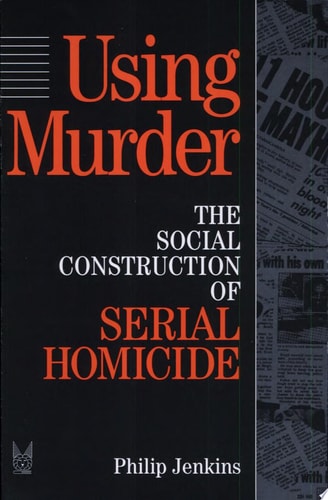
Using Murder: The Social Construction of Serial Homicide
0
0
As an Amazon Associate and affiliate partner, Menrva Books earns from qualifying purchases. Learn more
Author Description
In the last decade, serial murder has become a source of major concern for law enforcement agencies, while the serial killer has attracted widespread interest as a villain in popular culture. There is no doubt, however, that popular fears and stereotypes have vastly exaggerated the actual scale of multiple homicide activity. In assessing the concern and the interest, Jenkins has produced an innovative synthesis of approaches to social problem construction. It includes an historical and social-scientific estimate of the objective scale of serial murder; a rhetorical analysis of the construction of the phenomenon in public debate; and a cultural studies-oriented analysis of the portrayal of serial murder in contemporary literature, film, and the mass media.Using Murder suggests that a problem of this sort can only be understood in the context of its political and rhetorical dimension; that fears of crime and violence are valuable for particular constituencies and interest groups, which put them to their own uses. In part, these agendas are bureaucratic, in the sense that exaggerated concern about the offense generates support for criminal justice agencies. But other forces are at work in the culture at large, where serial murder has become an invaluable rhetorical weapon in public debates over issues like gender, race, and sexual orientation.Serial murder is worthy of study not so much for its intrinsic significance, but rather for what it suggests about the concerns, needs, and fears of the society that has come to portray it as an 'ultimate evil.' Using Murder is a highly original study of a powerful contemporary mythology by a criminologist and historian versed in the constructionist literature on the origins of 'moral panics.'
Menrva's Summary
THE THESIS
This book investigates the discrepancy between the actual prevalence of serial homicide and its inflated status as a pervasive social threat. Philip Jenkins, a criminologist and historian, utilizes a constructionist framework to analyze how serial murder is framed as a 'moral panic' within public discourse. He argues that the phenomenon is frequently manipulated by bureaucratic entities and political interest groups to serve specific agendas, rather than reflecting an objective rise in criminal activity.
THE SCOPE MAP
What You Will Find
- Historical and social-scientific data estimating the actual scale of serial homicide.
- Rhetorical analysis of how serial murder is constructed in public and political debate.
- Cultural studies examination of serial killers in film, literature, and mass media.
- Analysis of how crime fears are utilized to influence debates on gender, race, and sexual orientation.
THE AUTHORITY PERSPECTIVE
Experts recognize this work as a foundational text for understanding the sociology of moral panics and the media construction of crime. Readers frequently note the academic density of the prose, which provides a rigorous challenge to popular misconceptions regarding serial homicide.
Page Count:
272
Publication Date:
1994-12-31
Publisher:
Routledge
ISBN-10:
0202305252
ISBN-13:
9780202305257
History
True Crime
Media Studies
Sociology
Criminology
Serial Murders
Community Tags
Similar Books