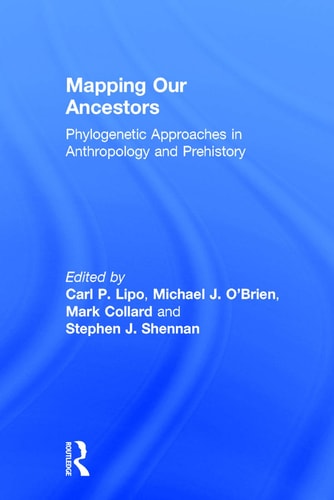
Mapping Our Ancestors: Phylogenetic Approaches in Anthropology and Prehistory
0
0
As an Amazon Associate and affiliate partner, Menrva Books earns from qualifying purchases. Learn more
Author Description
Much of what we are comes from our ancestors. Through cultural and biological inheritance mechanisms, our genetic composition, instructions for constructing artifacts, the structure and content of languages, and rules for behavior are passed from parents to children and from individual to individual. Mapping Our Ancestors demonstrates how various genealogical or "phylogenetic" methods can be used both to answer questions about human history and to build evolutionary explanations for the shape of history.Anthropologists are increasingly turning to quantitative phylogenetic methods. These methods depend on the transmission of information regardless of mode and as such are applicable to many anthropological questions. In this way, phylogenetic approaches have the potential for building bridges among the various subdisciplines of anthropology; an exciting prospect indeed. The structure of Mapping Our Ancestors reflects the editors' goal of developing a common understanding of the methods and conditions under which ancestral relations can be derived in a range of data classes of interest to anthropologists. Specifically, this volume explores the degree to which patterns of ancestry can be determined from artifactual, genetic, linguistic, and behavioral data and how processes such as selection, transmission, and geography impact the results of phylogenetic analyses.Mapping Our Ancestors provides a solid demonstration of the potential of phylogenetic methods for studying the evolutionary history of human populations using a variety of data sources and thus helps explain how cultural material, language, and biology came to be as they are.
Menrva's Summary
THE THESIS
This volume investigates the extent to which quantitative phylogenetic methods can reconstruct human history and evolutionary patterns across diverse data classes. Stephen Shennan, a prominent scholar in archaeological theory and quantitative methods, compiles research that bridges the gap between biological evolution and cultural transmission. The text argues that by applying genealogical models to artifacts, language, and genetic data, researchers can develop a unified framework for understanding the mechanisms of human inheritance and behavioral development.
THE SCOPE MAP
What You Will Find
- Quantitative phylogenetic methodologies applied to anthropological data sets.
- Comparative analysis of transmission modes in biological, linguistic, and artifactual records.
- Examination of how geography and selection pressures influence evolutionary outcomes.
- Theoretical frameworks for integrating disparate subdisciplines within anthropology.
THE AUTHORITY PERSPECTIVE
Experts recognize this volume as a significant contribution to the application of evolutionary biology techniques within the social sciences. Readers frequently note the technical density of the prose, which serves as a foundational resource for researchers interested in the intersection of quantitative modeling and prehistory.
Page Count:
372
Publication Date:
2005-01-07
Publisher:
Routledge
ISBN-10:
0202307506
ISBN-13:
9780202307503
Prehistory
Linguistics
Phylogeny
Anthropology
Archaeology
Genetics
Evolutionary Biology
Community Tags
Similar Books