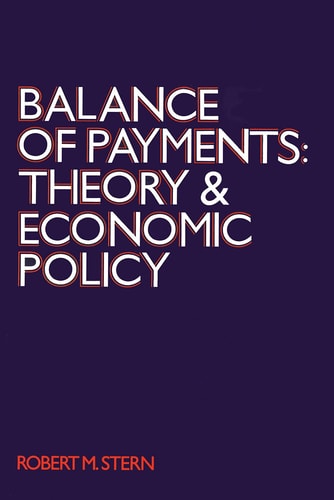
Balance of Payments: Theory and Economic Policy
0
0
As an Amazon Associate and affiliate partner, Menrva Books earns from qualifying purchases. Learn more
Author Description
An original and systematic synthesis of the major postwar developments in theory and policy of balance-of-payments adjustment, this book focuses on the present-day system of pegged-but-adjustable exchange rates and the problems that policy authorities must face if they are to attain full employment, price stability, balance-of-payments equilibrium, and a satisfactory rate of economic growth. The dominate theme of this book is that any system of exchange rates carries with it assumptions about the way it works and how effective the automatic and policy-motivated forces operate to bring about equilibrium in a country's balance of payments. By analyzing balance-of-payments adjustment and policies under alternative exchange-rate systems, and with different assumptions concerning the level of employment and prices, it is possible to embrace a wide variety of contemporary and historical circumstances experienced by individual countries and the world as a whole. In this way the author assesses the economic consequences of the different exchange-rate systems and of the policies that countries may follow to attain their national objectives. In particular it appears to Professor Stern that the international monetary turmoil of the past ten years can be traced to the exchange-rate inflexibilities of the adjustable-peg system and to the creation of excessive reserves under the dollar standard. He demonstrates that the international monetary system must be redesigned to permit greater exchange-rate inflexibility and control over the creation of new international reserve assets.
Menrva's Summary
THE THESIS
This book investigates the structural failures of the postwar international monetary system and proposes necessary reforms to achieve global economic equilibrium. Robert Stern, a noted economist, utilizes historical data and theoretical modeling to evaluate the efficacy of the pegged-but-adjustable exchange rate system. He argues that the international monetary instability observed in the late 20th century stems from exchange-rate rigidity and the mismanagement of international reserve assets under the dollar standard.
THE SCOPE MAP
What You Will Find
- Analysis of balance-of-payments adjustment mechanisms under varying exchange-rate regimes.
- Evaluation of policy tools for achieving full employment, price stability, and economic growth.
- Examination of the historical impact of the dollar standard on global reserve creation.
- Theoretical framework for redesigning international monetary systems to improve flexibility.
THE AUTHORITY PERSPECTIVE
Economists and students of international finance view this work as a rigorous examination of the mechanics governing global monetary policy. Readers frequently note the academic density of the prose, which serves as a foundational text for understanding the transition from the adjustable-peg system to modern monetary frameworks.
Page Count:
454
Publication Date:
2007-01-15
Publisher:
Routledge
ISBN-10:
0202308936
ISBN-13:
9780202308937
Economics
Macroeconomics
Finance
Community Tags
Similar Books