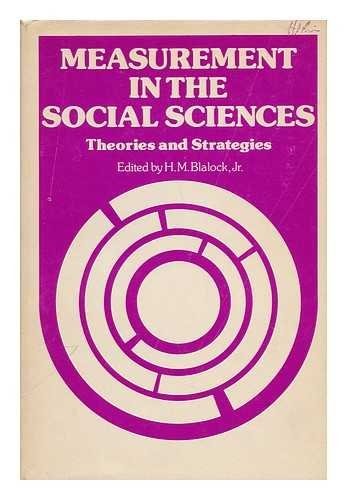
Measurement in the Social Sciences: Theories and Strategies
0
0
As an Amazon Associate and affiliate partner, Menrva Books earns from qualifying purchases. Learn more
Author Description
Among the frustrations constantly confronting the social scientist are those associated with the general process of measurement. The importance of good measurement has long been recognized in principle, but it has often been neglected in practice in many of the social sciences. Now that the methodological tools of multivariate analysis, simultaneous-equation estimation, and causal modeling are diffused more widely into the social sciences, and now that the very serious implications of random and non-random measurement errors are being systematically investigated, it is all the more important that social scientists give top priority to the quality of their data and the clarity of their theoretical conceptualizations. The book is organized so that, one proceeds from problems of data collection to those of data analysis. It is not intended to be a complete work covering all types of measurement problems that have arisen in the social sciences. Instead, it represents a series of studies that are deemed to be crucial for the advancement of social science research but which have not received sufficient attention in most of the social sciences. The basic purpose is to stimulate further methodological research on measurement and to study the ways in which knowledge that has been accumulated in some fields may be generalized. Part I is concerned with applying scaling approaches developed in psychometrics to problems that arise in other social sciences. The focus is on finding better ways to ask questions of respondents so as to raise the level of measurement above that of simple ordinal scales. Part II focuses on multiple-indicator theory and strategies as applied to relatively complex models and to change data. In this section the emphasis shifts to how one analyzes fallible data through the construction of explicit measurement-error models. Part III deals with the statistical analysis of ordinal data, including the interpretation and empirical behaviors of various ordinal
Menrva's Summary
THE THESIS
This volume investigates the persistent challenges of measurement quality and theoretical conceptualization within the social sciences. Editor H. M. Blalock compiles a series of methodological studies aimed at addressing the neglect of rigorous measurement practices. By integrating tools from multivariate analysis and causal modeling, the text argues for a systematic approach to identifying and mitigating random and non-random measurement errors in research data.
THE SCOPE MAP
What You Will Find
- Psychometric scaling approaches applied to broader social science research
- Multiple-indicator theory and strategies for complex modeling
- Methodologies for analyzing fallible data through explicit measurement-error models
- Statistical analysis techniques for interpreting ordinal data
THE AUTHORITY PERSPECTIVE
Experts recognize this work as a foundational text for understanding the intersection of psychometrics and social science research. Readers frequently note the technical density of the prose, which serves as a critical resource for researchers seeking to improve data validity and model accuracy.
Page Count:
464
Publication Date:
1974-01-01
Publisher:
Aldine
ISBN-10:
0202302717
ISBN-13:
9780202302713
Research Methods
Data Analysis
Social Science
Methodology
Statistics
Community Tags
Similar Books