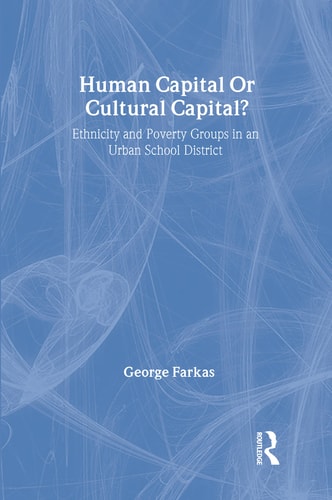
Human Capital or Cultural Capital?: Ethnicity and Poverty Groups in an Urban School District
0
0
As an Amazon Associate and affiliate partner, Menrva Books earns from qualifying purchases. Learn more
Author Description
This study seeks to reorient our understanding of the early educational determinants of social stratification outcomes. It focuses on the process and consequences of unequal cognitive skill attainment for ethnic and poverty groups within our nation's cities. It draws, theoretically, on the notion that experiences at home and school create a feedback loop by which the "cultural capital" of the students (their toolkit of skills, habits, and styles with which they construct strategies of action) evolves over time and largely determines differential success in mastering the teacher-assigned homework.
Menrva's Summary
THE THESIS
This study investigates whether disparities in educational outcomes are primarily driven by human capital or cultural capital within urban school districts. George Farkas, a sociologist specializing in educational inequality, utilizes longitudinal data from urban school settings to examine how student habits, skills, and home environments interact with school expectations. He argues that the feedback loop between a student's cultural toolkit and teacher-assigned tasks creates a mechanism that perpetuates social stratification over time.
THE SCOPE MAP
What You Will Find
- Longitudinal analysis of cognitive skill attainment across diverse ethnic and socioeconomic groups.
- Theoretical framework examining the role of cultural capital in academic performance.
- Quantitative assessment of the feedback loop between home environment and classroom success.
- Examination of teacher-assigned homework as a primary site for skill development and stratification.
THE AUTHORITY PERSPECTIVE
Experts in the sociology of education recognize this work as a significant contribution to the debate surrounding the origins of the achievement gap. Readers frequently note the academic density of the prose and the rigorous statistical approach employed to isolate cultural factors from traditional human capital variables.
Page Count:
216
Publication Date:
1996-12-31
Publisher:
Routledge
ISBN-10:
0202305236
ISBN-13:
9780202305233
United States
Human Capital
Reading comprehension
Minorities
Remedial teaching
Urban Studies
Sociology
Public Policy
Education