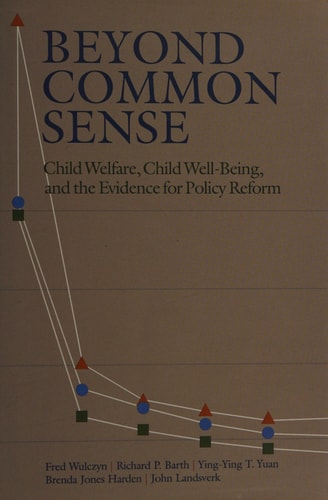
Beyond Common Sense: Child Welfare, Child Well-Being, and the Evidence for Policy Reform
0
0
As an Amazon Associate and affiliate partner, Menrva Books earns from qualifying purchases. Learn more
Author Description
Helping vulnerable children develop their full potential is an attractive idea with broad common-sense appeal. However, child well-being is a broad concept, and the legislative mandate for addressing well-being in the context of the current child welfare system is not particularly clear. This volume asserts that finding a place for well-being on the list of outcomes established to manage the child welfare system is not as easy as it first appears. The overall thrust of this argument is that policy should be evidence-based, and the available evidence is a primary focus of the book. Because policymakers have to make decisions that allocate resources, a basic understanding of incidence in the public health tradition is important, as is evidence that speaks to the question of what works clinically. The rest of the book addresses the evidence. Chapter 2 integrates bio-ecological and public health perspectives to give the evidence base coherence. Chapters 3 and 4 combine evidence from the National Child Abuse and Neglect Data System, the Multistate Foster Care Data Archive, and the National Survey of Child and Adolescent Well-Being to offer an unprecedented profile of children as they enter the child welfare system. Chapters 5 and 6 address the broad question of what works. A concluding chapter focuses on policy and future directions, suggesting that children starting out, children starting school, and children starting adolescence are high-risk populations for which explicit strategies have to be formed. This timely volume offers useful insights into the child welfare system and will be of particular interest to policymakers, academics with an interest in Child Welfare Policy, Social Work educators, and Child Advocates.
Menrva's Summary
THE THESIS
This volume investigates how the child welfare system can transition from vague common-sense goals to evidence-based policy that effectively promotes child well-being. The authors, a team of distinguished researchers and academics in social work and public health, argue that current legislative mandates lack the clarity required for resource allocation. By integrating bio-ecological models with public health data, they provide a rigorous framework for evaluating clinical interventions and systemic outcomes.
THE SCOPE MAP
What You Will Find
- Analysis of data from the National Child Abuse and Neglect Data System and the Multistate Foster Care Data Archive.
- Integration of bio-ecological and public health perspectives to evaluate child welfare outcomes.
- Examination of high-risk developmental stages including early childhood, school entry, and adolescence.
- Evidence-based assessment of clinical interventions and resource allocation strategies.
THE AUTHORITY PERSPECTIVE
Experts identify this work as a foundational text for understanding the intersection of data-driven research and child welfare legislation. Readers frequently note the academic density of the prose, which serves as a primary resource for policymakers and social work educators.
Page Count:
227
Publication Date:
2005-06-30
Publisher:
Routledge
ISBN-10:
0202307352
ISBN-13:
9780202307350
Education
Child Welfare
Sociology
Social Work
Public Policy
Community Tags
Other Editions(2)
Similar Books










Reader Comments
Share Your Thoughts
No comments yet. Be the first to share your thoughts!