
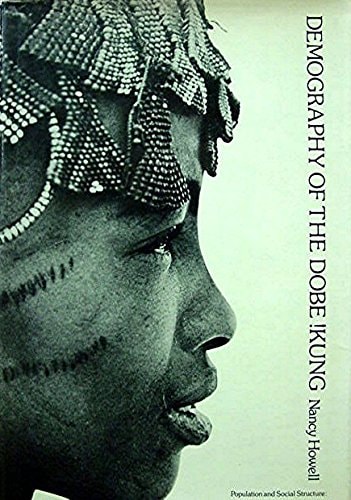
Demography of the Dobe !Kung
0
0
As an Amazon Associate and affiliate partner, Menrva Books earns from qualifying purchases. Learn more
Author Description
First published in 1979, this is a classic study of the population of the Bushmen of the Kalahari Desert of Botswana. Using methods that are simple and fully illustrated, the author presents empirical descriptions of the fertility, mortality, and marriage patterns of the now famous!Kung hunter-gatherers. The!Kung "Bushman" people of the Kalahari desert in Africa occupy an anomalous position in the world of science. They have been selected for intensive study precisely because they are geographically, socially, and economically removed from modern, industrialized society, living in a sparsely settled and remote portion of an enormous semidesert. The!Kung maintain the language and culture of a fully developed hunting and gathering society with (until very recently) no dependence on cultivated plants, no domesticated animals other than the dog, no stratification system based on kinship or occupation, no power or authority structure extending further than the local bands composed of a few related families, no wage labor, no use of money, and no settled sites of occupation. At the same time, the!Kung have become well-known figures to students—both undergraduate and professional—of Western social science. The faces of!Kung informants gaze from the covers and the illustrations of many texts in anthropology and sociology. Why has all this attention been developed around the!Kung people? Part of the answer lies in the people themselves. The!Kung are a physically attractive people, with slender, graceful bodies and open small-featured faces that are appealing and photogenic. Their culture is simple and has its striking features. The struggle for subsistence, the click language, the emphasis on sharing and humility, the drama of the curing dances in which individuals go into trance and speak directly to spirits to cure sickness, and the pervasive humor, teasing, and playfulness of the!Kung style are all features that are relatively easy to convey and interesting to learn about.
Menrva's Summary
THE THESIS
This study investigates the demographic dynamics of the !Kung hunter-gatherers to understand the population patterns of a society operating outside the influence of modern industrialization. Nancy R. Howell, an anthropologist, utilizes empirical data collected from the Kalahari Desert to analyze the fundamental biological and social mechanisms governing fertility, mortality, and marriage. By focusing on a group with minimal external economic dependence, the author provides a baseline for human behavioral evolution and population stability.
THE SCOPE MAP
What You Will Find
- Quantitative analysis of fertility and mortality rates within !Kung bands.
- Examination of marriage patterns and kinship structures in a non-stratified society.
- Empirical data regarding subsistence strategies and population density in semi-desert environments.
- Methodological frameworks for conducting demographic research in remote, non-industrialized populations.
THE AUTHORITY PERSPECTIVE
Experts recognize this work as a foundational text in anthropological demography, frequently cited for its rigorous data collection in a challenging field environment. Readers often note the technical density of the statistical analysis, which provides a clear, objective look at the biological realities of hunter-gatherer life.
Page Count:
412
Publication Date:
2001-01-01
Publisher:
Routledge
ISBN-10:
020230650X
ISBN-13:
9780202306506
Social Science
Africa
Demography
Sociology
Anthropology
Community Tags
Other Editions(3)

Similar Books






Reader Comments
Share Your Thoughts
No comments yet. Be the first to share your thoughts!