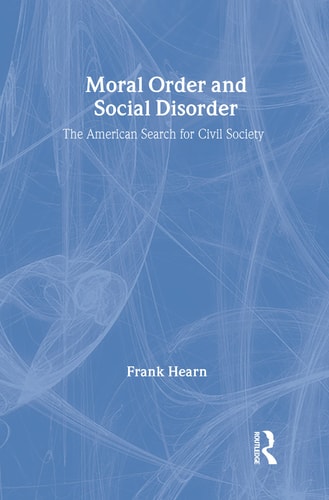
Moral Order and Social Disorder: American Search for Civil Society
0
0
As an Amazon Associate and affiliate partner, Menrva Books earns from qualifying purchases. Learn more
Author Description
Drawing upon both classical insights and more recent writings, Hearn provides a compelling account of social breakdown in the United States. The book examines the conditions most responsible for the deterioration of social institutions, notably the family, and of communitarian interdependencies, such as those that support neighborhoods. More specifically, Hearn analyzes the defining forces of liberal modernity--among them, especially, the market economy (favored by the political right) and the democratic welfare state (endorsed by the political left)--whose steady expansion has diminished the social contexts that nurture trust, mutuality, and a robust sense of both personal responsibility and social obligation.The originality of Hearn's book lies in the solutions he proposes, which differ from those rooted in what Hearn calls "the languages of modernity." Hearn advocates modes that would serve instead to renew solidarity and reclaim social virtue, a repertory of strategies that would answer Emile Durkheim's call for the creation of moral individualism. He assesses various approaches to revitalizing the social settings, the social institutions, and communitarian structures within which people become moral individuals capable of care about and taking responsibility for the fates of others.Readers of this book are invited to draw their own conclusions by relying in larger part on themselves as parents, neighbors, community members, and citizen-participants in a civil society in restoration. As the American Journal of Sociology notes, "the book succeeds in its goals, and it deserves to be widely read." Frank Hearn was professor of sociology at the State University of New York, College of Cortland, and the author of Reason and Freedom in Sociological Thought and The Transformation of Industrial Organization.
Menrva's Summary
THE THESIS
This book investigates the structural causes of social breakdown in the United States and proposes a framework for restoring civil society through moral individualism. Frank Hearn, a professor of sociology, synthesizes classical sociological theory with contemporary analysis to critique the expansion of both market economies and the welfare state. He argues that these forces have eroded the local institutions and communitarian interdependencies necessary for fostering trust and social responsibility. The text serves as a diagnostic tool for understanding the decline of social cohesion and offers a normative path toward revitalizing the institutions that shape moral individuals.
THE SCOPE MAP
What You Will Find
- Analysis of the impact of liberal modernity on family and neighborhood structures.
- Critique of the market economy and the democratic welfare state as drivers of social atomization.
- Application of Durkheimian concepts to modern American social challenges.
- Strategies for reclaiming social virtue and personal responsibility within local communities.
THE AUTHORITY PERSPECTIVE
Experts and academic reviewers recognize this work as a significant contribution to the study of social institutions and the American civil landscape. Readers frequently note the academic density of the prose, which requires a foundational understanding of sociological theory to fully appreciate the author's arguments.
Page Count:
206
Publication Date:
1997-01-01
Publisher:
Aldine Transaction
ISBN-10:
0202306038
ISBN-13:
9780202306032
United States
Social Theory
Sociology
Civil society
American Studies
Community Tags
Other Editions(3)

Similar Books










Reader Comments
Share Your Thoughts
No comments yet. Be the first to share your thoughts!