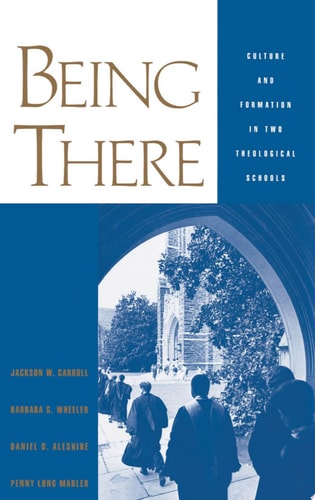
Being There: Culture and Formation in Two Theological Schools
0
0
As an Amazon Associate and affiliate partner, Menrva Books earns from qualifying purchases. Learn more
Author Description
This book offers a close-up look at theological education in the U.S. today. The authors' goal is to understand the way in which institutional culture affects the outcome of the educational process. To that end, they undertake ethnographic studies of two seminaries-one evangelical and one mainline Protestant. These studies, written in a lively journalistic style, make up the first part of the book and offer fascinating portraits of two very different intellectual, religious, and social worlds.The authors go on to analyze these disparate environments, and suggest how in each case corporate culture acts as an agent of educational change. They find two major consequences stemming from the culture of each school. First, each culture gives expression to a normative goal that aims at shaping the way students understand themselves and from issues of ministry practice. Second, each provides a "cultural tool kit" of knowledge, practices, and skills that students use to construct strategies of action for the various problems and issues that will confront them as pastors or in other forms of ministry. In the concluding chapters, the authors explore the implications of their findings for theories of institutional culture and professional socialization and for interpreting the state of religion in America. They identify some of the practical dilemmas that theological and other professional schools currently face, and reflect on how their findings might contribute to their solution. This accessible, thought-provoking study will not only illuminate the structure and process by which culture educates and forms, but also provide invaluable insights into important dynamics of American religious life.
Menrva's Summary
THE THESIS
This book investigates how the specific institutional culture of theological schools shapes the professional formation and identity of students entering ministry. The authors, a team of experienced researchers in religious education and sociology, utilize ethnographic data to examine the divergence between evangelical and mainline Protestant seminaries. They argue that corporate culture functions as a primary agent of educational change, providing students with a distinct toolkit of knowledge and practices that define their future professional strategies.
THE SCOPE MAP
What You Will Find
- Ethnographic case studies of two distinct American seminaries.
- Comparative analysis of evangelical versus mainline Protestant institutional environments.
- Theoretical framework regarding professional socialization and institutional culture.
- Practical implications for the future of theological education and professional training.
THE AUTHORITY PERSPECTIVE
Experts in the field of religious studies frequently cite this work as a foundational text for understanding the intersection of organizational culture and ministerial formation. Readers note that the prose remains accessible while providing a rigorous examination of the social dynamics within professional schools.
Page Count:
320
Publication Date:
1997-10-16
Publisher:
Oxford University Press
ISBN-10:
0195114930
ISBN-13:
9780195114935
Religion
Sociology
Education
Theological Seminaries
Education higher
Theology
Study & Teaching
American Studies
United States
Community Tags
Similar Books