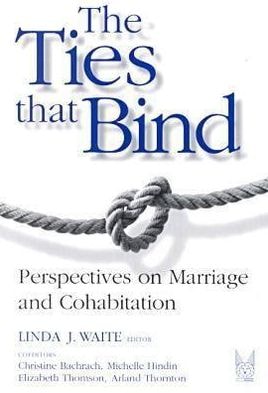
The Ties That Bind: Perspectives on Marriage and Cohabitation
0
0
As an Amazon Associate and affiliate partner, Menrva Books earns from qualifying purchases. Learn more
Author Description
Product Description The Ties That Bindwas organized to review and assess the scientific evidence about the causes of trends in marriage and other forms of intimate unions. The contributors address these two questions: What do we know about the factors that influence the formation of marriages and other intimate unions, the timing of union formation, and the forms that unions take? What factors explain the dramatic changes in union formation we have observed over recent decades? Edited by Linda J. Waite. Co-edited by Christine Bachrach, Michelle Hindin, Elizabeth Thomson, and Arland Thornton. Review “Marriage and cohabitation may be seen as assets, in some ways like wealth. Like wealth, there are aspects of choice and constraint in the determination of who gets these relationships. Who enters and stays in marriage or cohabitation, and the relative gains or losses that result, are structured by gender in ways that differ across racial/ethnic and other groupings. For better or for worse, married and cohabitating people have things that others do not. Understanding what those things are and how they are changing is crucial to figuring out why there have been such dramatic developments in recent decades in the rates of non-marital cohabitation, later marriage timing and more people not married, and the disassociation of childbirth and childrearing from married relationships. The Ties That Bind describes, explains, and theorizes these trends…. The collection is clearly conceptualized and motivated, and… the pieces are quite useful.” —Philip N. Cohen, Contemporary Sociology
Menrva's Summary
THE THESIS
This volume investigates the underlying causes and societal drivers behind the shifting patterns of marriage and cohabitation in contemporary society. Edited by Linda J. Waite and a team of distinguished sociologists, the text synthesizes empirical research to explain why intimate union formation has undergone such dramatic transformations in recent decades. The contributors utilize longitudinal data and demographic analysis to evaluate how economic, cultural, and structural factors influence the timing and nature of these relationships.
THE SCOPE MAP
What You Will Find
- Analysis of trends in non-marital cohabitation and delayed marriage timing.
- Examination of the disassociation between childbirth and formal marriage.
- Evaluation of how gender, race, and ethnicity structure access to intimate unions.
- Theoretical frameworks explaining the evolution of social institutions over time.
THE AUTHORITY PERSPECTIVE
Experts and reviewers in the field of sociology characterize this work as a well-conceptualized and essential resource for understanding modern demographic shifts. Scholars frequently note the academic rigor of the contributions, making it a foundational text for those studying the intersection of family life and social policy.
Page Count:
404
Publication Date:
2000-08-31
Publisher:
Routledge
ISBN-10:
0202306356
ISBN-13:
9780202306353
Unmarried Couples
Domestic Relations
Sociology
Social change
Marriage
Demography
Family Studies