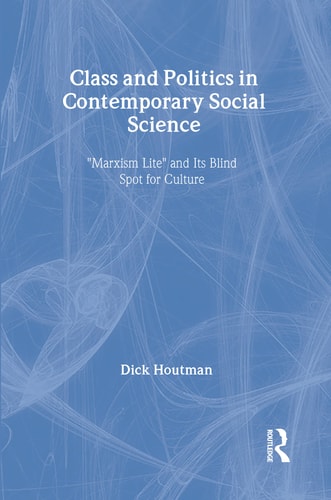
Class and Politics in Contemporary Social Science: Marxism Lite and Its Blind Spot for Culture
0
0
As an Amazon Associate and affiliate partner, Menrva Books earns from qualifying purchases. Learn more
Author Description
Dick Houtman argues that neither authoritarianism nor libertarianism can be explained by class or economic background, but rather by position in the cultural domain-- what he calls cultural capital. Although he examines all of the statistics and arguments of the conventional approaches with care and concern, Houtman convincingly demonstrates that the conclusions drawn from earlier studies are untenable at a more general theoretical level. Despite differences among advocates of class explanations, their theories are based on largely identical research findings--in particular a strong negative relationship between education and authoritarianism. Unobstructed by the conclusions these authors felt called upon to draw from the findings themselves, Houtman configures them in a new way. The hypotheses derived from this new theory allow for a systematic, strict, and competitive testing of original theses without ignoring the value of and earlier research. After demonstrating that authoritarianism and libertarianism cannot be explained by class or economic background, Houtman examines the implications of this argument for today's death of class debate in political sociology. He holds it to be unfortunate that the relevance of class to politics is typically addressed by studying the relation between class and voting. This conceals a complex cross-pressure mechanism that causes this relationship to capture the net balance of class voting and its opposite, cultural voting, instead of class voting. He argues that references to a decline in class voting may be basically correct, but dogmatic reliance on the relation between class and voting to prove the point systematically underestimates levels of class voting and produces an exaggerated picture of the decline.
Menrva's Summary
THE THESIS
Does the traditional reliance on class and economic background adequately explain the emergence of authoritarianism and libertarianism in contemporary political sociology? Dick Houtman, a scholar specializing in cultural sociology and political behavior, challenges the prevailing consensus that class remains the primary determinant of political orientation. By re-evaluating existing statistical data through the lens of cultural capital, Houtman argues that cultural positioning, rather than economic status, serves as the true driver of political values and voting behavior.
THE SCOPE MAP
What You Will Find
- A critical re-examination of the relationship between education levels and authoritarian political tendencies.
- The introduction of the cultural capital framework as an alternative to traditional class-based analysis.
- A methodological critique of how political sociologists measure class voting and its perceived decline.
- An analysis of the cross-pressure mechanism that obscures the true impact of class on electoral outcomes.
THE AUTHORITY PERSPECTIVE
Scholars in the field of political sociology frequently cite this work for its rigorous methodological challenge to established class-based paradigms. Experts note that the text provides a dense, data-driven argument that forces a re-evaluation of how cultural variables are integrated into political research.
Page Count:
224
Publication Date:
2004-04-30
Publisher:
Routledge
ISBN-10:
0202306887
ISBN-13:
9780202306889
Liberalism
Social Classes
Sociology
Netherlands economic conditions
Marxism
Conservatism
Community Tags
Other Editions(3)

Similar Books








Reader Comments
Share Your Thoughts
No comments yet. Be the first to share your thoughts!