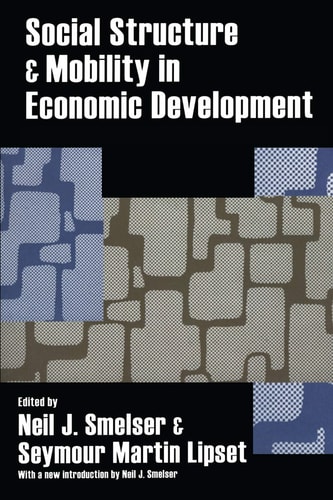
Social Structure and Mobility in Economic Development
0
0
As an Amazon Associate and affiliate partner, Menrva Books earns from qualifying purchases. Learn more
Author Description
The foundation of this volume is the notion that the several processes of change constituting economic and social development are systematically interrelated. The essence of development is the appearance of rapid rates of increases in many different indices--output per capita, political participation, literacy and the like. These quantitative changes are, however, commonly accompanied by vast changes in the social structure--markets emerge, political bureaucracies arise, and new educational systems appear. Written by the leading authorities on the subject, this group of papers tackles the causes and consequences of social mobility. Each author brings his particular skills to bear on various aspects of the problem in studies of persons moving from rural to urban settings, from one kind of industry to another and from one prestige level to another. Several of the papers review the theoretical and methodological issues involved in comparative research on social mobility while others compare and contrast traditional and modern stratification systems. Various papers explore the economic, religious and psychological basis of social mobility, concluding with enquiry into the consequences of rapid mobility, especially in terms of the political stability of developing nations. Because social mobility is a central consideration in any study of economic and social change, every student of change will use this pioneering reference source as a text for all future research. Contributors include Otis Dudley Duncan, Harold L. Wilensky, Michael G. Smith, Bert F. Hoselitz, Wilbert E. Moore, Natalie Rogoff Rams°y, Gideon Sjoberg, Reinhard Bendix, Harry Crockett, David Matza, Lester Seligman, and Gino Germani. Neil J. Smelser is emeritus professor, Department of Sociology, University of California, Berkeley. Seymour Martin Lipset was professor of sociology and director of the Institute of International Studies at the University of California, Berkeley.
Menrva's Summary
THE THESIS
This volume investigates the systematic interrelation between economic development and the transformation of social structures within modernizing nations. The author, a prominent sociologist, compiles a series of scholarly papers that examine how quantitative indices of growth—such as literacy, political participation, and per capita output—correlate with qualitative shifts in stratification and social mobility. By integrating diverse theoretical frameworks, the text argues that understanding the movement of individuals across prestige levels and industries is essential to predicting the political stability of developing societies.
THE SCOPE MAP
What You Will Find
- Comparative analysis of traditional versus modern stratification systems.
- Methodological frameworks for conducting cross-national research on social mobility.
- Case studies examining rural-to-urban migration and industrial shifts.
- Investigations into the economic, religious, and psychological drivers of individual status change.
THE AUTHORITY PERSPECTIVE
Experts recognize this collection as a foundational reference for students of social change and development economics. Readers frequently note the academic density of the prose and the historical significance of the contributors' collective research.
Page Count:
418
Publication Date:
2005-06-30
Publisher:
Routledge
ISBN-10:
0202307999
ISBN-13:
9780202307992
Economics
Sociology
Social Classes
Community Tags
Similar Books