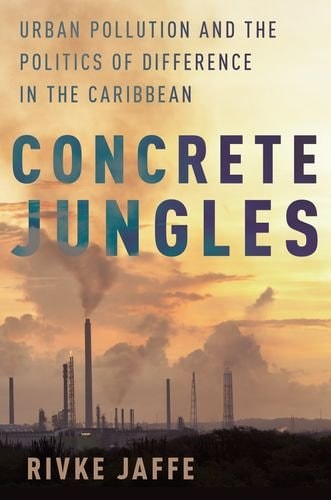
Concrete Jungles: Urban Pollution and the Politics of Difference in the Caribbean
0
0
As an Amazon Associate and affiliate partner, Menrva Books earns from qualifying purchases. Learn more
Author Description
In the popular imagination, the Caribbean islands represent tropical paradise. This image, which draws millions of tourists to the region annually, underlies the efforts of many environmentalists to protect Caribbean coral reefs, mangroves, and rainforests. However, a dark side to Caribbean environmentalism lies beyond the tourist's view in urban areas where the islands' poorer citizens suffer from exposure to garbage, untreated sewage, and air pollution.Concrete Jungles explores the reasons why these issues tend to be ignored, demonstrating how mainstream environmentalism reflects and reproduces class and race inequalities. Based on over a decade of research in Kingston, Jamaica and Willemstad, Curaçao, Rivke Jaffe contrasts the environmentalism of largely middle-class professionals with the environmentalism of inner-city residents. The book combines a sophisticated discussion of the politics of difference with rich ethnographic detail, including vivid depictions of Caribbean ghettos and elite enclaves. Jaffe also extends her analysis beyond ethnographic research, seeking to understand the role of colonial history in shaping the current trends in pollution and urban space.A thorough analysis of the hidden inequalities of mainstream environmentalism, Concrete Jungles provides a political ecology of urban pollution with significant implications for the future of environmentalism.
Menrva's Summary
THE THESIS
This book investigates why urban pollution in the Caribbean is frequently overlooked by mainstream environmental movements and how these blind spots reinforce existing racial and class hierarchies. Rivke Jaffe, an anthropologist specializing in urban environments and political ecology, utilizes over a decade of field research conducted in Kingston, Jamaica, and Willemstad, Curaçao. She argues that the prevailing focus on preserving pristine natural landscapes for tourism obscures the environmental hazards faced by marginalized populations in urban centers. By examining the intersection of colonial history and contemporary urban planning, Jaffe provides a framework for understanding how environmentalism can inadvertently perpetuate social inequality.
THE SCOPE MAP
What You Will Find
- Comparative ethnographic analysis of Kingston, Jamaica, and Willemstad, Curaçao.
- Examination of the disconnect between middle-class environmental priorities and inner-city health concerns.
- Analysis of the historical influence of colonialism on modern urban spatial organization and waste management.
- Theoretical exploration of the politics of difference within environmental discourse.
Scope Limits
- The study does not provide a comprehensive survey of all Caribbean nations, focusing specifically on the two aforementioned urban centers.
- The text does not offer a technical manual for pollution mitigation or engineering solutions.
THE AUTHORITY PERSPECTIVE
Scholars in the fields of political ecology and urban anthropology identify this work as a significant contribution to the study of environmental justice in the Global South. Readers frequently note the academic density of the prose and the effectiveness of the author's comparative methodology in highlighting systemic inequalities.
Page Count:
206
Publication Date:
2016-01-01
Publisher:
Oxford University Press
ISBN-10:
0190273585
ISBN-13:
9780190273583
Pollution
Urban Studies
Sociology
Human ecology
Anthropology
Caribbean Area
Caribbean Studies
Social Classes
Community Tags
Similar Books