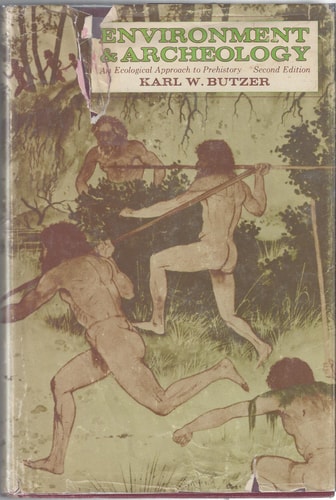
Environment and Archeology: An Ecological Approach to Prehistory
0
0
As an Amazon Associate and affiliate partner, Menrva Books earns from qualifying purchases. Learn more
Author Description
The book is divided into six parts, presenting both techniques and applications of paleo-environmental studies, focused on archeological contexts and man-land relationships. Part I gives a brief historical sketch of the role of interdisciplinary work in prehistorica archeology. Part II deals with the significance of vegetation, soils, and geomorphology as environmental indices and gives a nontechnical overview of geomorphologic processes. Part II is a systematic description of Pleistocene sediments. Part IV considers the biological sciences relevant to environmental reconstruction. Part V includes regional reconstructions of the late Pleistocene environments for North America, Europe, the Mediterranean Basin, and Africa. Part VI, which comprises a third of the book, deals with man-land interactions.
Menrva's Summary
THE THESIS
How can the integration of environmental data and archaeological evidence provide a comprehensive understanding of human-land interactions during prehistory? Karl W. Butzer, a distinguished scholar in the field of human geography and archaeology, presents a systematic framework for paleo-environmental reconstruction. By synthesizing geomorphology, sedimentology, and biological sciences, the author argues that archaeological sites must be interpreted within their specific ecological contexts to understand the evolution of human societies.
THE SCOPE MAP
What You Will Find
- A comprehensive framework for analyzing Pleistocene sediments and environmental indices.
- Methodologies for reconstructing regional environments across North America, Europe, the Mediterranean, and Africa.
- Analysis of man-land interactions, focusing on how prehistoric populations adapted to shifting ecological conditions.
- Historical overview of interdisciplinary collaboration between archaeological and environmental sciences.
THE AUTHORITY PERSPECTIVE
Experts recognize this work as a foundational text for students and professionals in archaeology and environmental history. Readers frequently note the academic density of the prose, which serves as a rigorous reference for those engaged in field-based paleo-environmental research.
Page Count:
703
Publication Date:
1971-01-01
Publisher:
Aldine, Atherton
ISBN-10:
0202330230
ISBN-13:
9780202330235
Anthropology
Paleontology
Geomorphology
Prehistory
Archaeology
Prehistoric peoples
Paleoecology
Community Tags
Similar Books