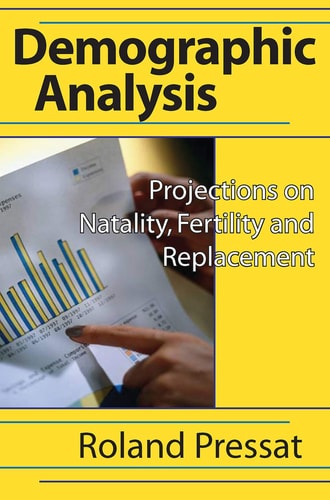
Demographic Analysis: Projections on Natality, Fertility and Replacement
0
0
As an Amazon Associate and affiliate partner, Menrva Books earns from qualifying purchases. Learn more
Author Description
Population control requires that the birth rate equal to the death rate. If it is too low population will decline; if it is too high, population will increase. If either condition persists long enough the population will diminish towards zero or increase towards infinity. Fortunately, the birth trajectory does not have to be set once and for all, but can be adjusted within limits. Since birth and death rates determine whether we are heading for population extinction or explosion, they are well designated "vital statistics." Their understanding and use are a central theme of demographic analysis."Demographic Analysis" presents those techniques that are often called for in the study of demographic problems. Such techniques permit researchers to fill the gap between the large amounts of data made available by censuses and the theoretical and practical questions that need to be answered; the techniques of this book effectively bring the data into confrontation with the problems. In his treatment of population projection, Pressat applies methods developed in earlier sections for mortality arid fertility. The emphasis is on population projection and accords with its usefulness in demographic analysis. The meaning of a demographic rate or trend is brought out by seeing to what condition it would lead if continued. No assumption is made that the concrete future will follow either path.The substance of the book is devoted to the main themes of mortality and fertility. Underlying these as well as nearly every other kind of data with which the demographer deals is the problem of location in time - the relation of vital events to the calendar, and also to the age of the persons undergoing them. Pressat's detailed attention to this problem forms a solid basis for how current methodology accounts of demographic changes.
Menrva's Summary
THE THESIS
How can researchers effectively utilize vital statistics to project future population trends and address the balance between birth and death rates? Roland Pressat, a noted demographer, provides a rigorous methodological framework for interpreting population data. By bridging the gap between raw census figures and theoretical inquiry, the author demonstrates how specific analytical techniques allow for the projection of mortality and fertility trends. The text argues that understanding these variables is essential for evaluating the long-term sustainability of population structures.
THE SCOPE MAP
What You Will Find
- Quantitative methods for calculating mortality and fertility rates.
- Techniques for reconciling vital events with calendar time and individual age cohorts.
- Methodological approaches to population projection based on current demographic trends.
- Analysis of the relationship between birth rates, death rates, and long-term population stability.
THE AUTHORITY PERSPECTIVE
Experts recognize this work as a foundational text for students and practitioners of formal demography. Readers frequently note the technical density of the prose, which requires a solid grasp of statistical principles to fully implement the methodologies described.
Page Count:
520
Publication Date:
2008-07-15
Publisher:
Routledge
ISBN-10:
0202361977
ISBN-13:
9780202361970
Statistics
Population Studies
Sociology
Social Science
Demography
Community Tags
Other Editions(2)

Similar Books



Reader Comments
Share Your Thoughts
No comments yet. Be the first to share your thoughts!