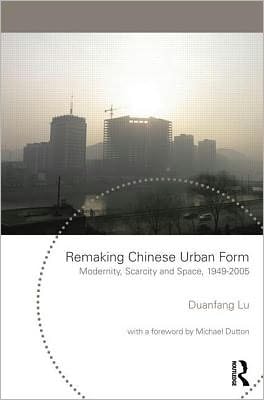
Remaking Chinese Urban Form
0
0
As an Amazon Associate and affiliate partner, Menrva Books earns from qualifying purchases. Learn more
Author Description
Socialist Space, Postcolonial Time -- Travelling Urban Form: The Neighbourhood Unit In China -- Work Unit Modernism -- The Socialist Production Of Space: Planning, Urban Contradictions, And The Politics Of Consumption In Beijing, 1949-1965 -- Modernity As Utopia: Planning The People's Commune, 1958-1960 -- The Latency Of Tradition: On The Vicissitudes Of Walls -- The New Frontier: Urban Space And Everyday Practice In The Reform Era -- Epilogue. Duanfang Lu. Includes Bibliographical References (p. [168]-198) And Index.
Menrva's Summary
THE THESIS
How did the intersection of socialist ideology, postcolonial identity, and rapid modernization fundamentally reshape the physical landscape of Chinese cities? Duanfang Lu, an expert in architectural history and urbanism, examines the transformation of Chinese urban environments from the mid-20th century to the contemporary reform era. By analyzing planning documents, architectural designs, and social practices, the author argues that urban form in China is not merely a product of technical planning but a manifestation of political struggle and utopian aspiration. The text provides a critical framework for understanding how global planning concepts were adapted to fit the unique requirements of the Chinese socialist state.
THE SCOPE MAP
What You Will Find
- Historical analysis of the neighbourhood unit model and work unit modernism in China.
- Examination of urban planning policies in Beijing between 1949 and 1965.
- Investigation into the utopian planning of the People's Commune era.
- Case studies on the persistence of traditional architectural elements like walls in modern settings.
- Discussion of the shift toward market-oriented urban practices during the reform era.
THE AUTHORITY PERSPECTIVE
Scholars and urbanists recognize this work as a significant contribution to the study of socialist architecture and the evolution of Chinese urbanism. Readers frequently note the academic density of the prose and the depth of the historical research provided by the author.
Page Count:
216
Publication Date:
2006-01-01
Publisher:
Routledge, Taylor & Francis Group
ISBN-10:
0203001192
ISBN-13:
9780203001196
History
Architecture
Histoire
Communism And Architecture
Sociology
Stadtbild
Stadtplanung
Urbanisme
China Studies
Danwei
urban planning
Community Tags
Similar Books