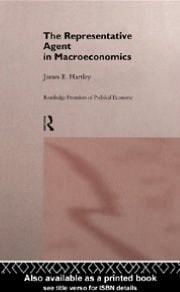
Representative Agent in Macroeconomics
0
0
As an Amazon Associate and affiliate partner, Menrva Books earns from qualifying purchases. Learn more
Author Description
Rpresentative agent models have become a predominant means of studying the macroeconomy in modern economics without there being much discussion in the literature about their propriety or usefulness. This volume evaluates the use of these models in macroeconomics, examining the justifications for their use and concluding that representative agent models are neither a proper nor a particularly useful means of studying aggregate behaviour.
Menrva's Summary
THE THESIS
This volume investigates the methodological validity and practical utility of representative agent models within the framework of modern macroeconomic analysis. James E. Hartley, an economist specializing in the history and methodology of economic thought, scrutinizes the foundational assumptions that allow researchers to treat aggregate economic behavior as the output of a single, idealized agent. By tracing the evolution of these models, the author argues that the reliance on representative agents often obscures the complexities of heterogeneous economic interactions and fails to provide a robust basis for understanding macroeconomic phenomena.
THE SCOPE MAP
What You Will Find
- A critical evaluation of the theoretical justifications for representative agent modeling.
- An analysis of the historical development of aggregate behavior models in economics.
- A methodological critique regarding the limitations of micro-foundations in macroeconomics.
- A concluding argument against the continued dominance of this specific modeling approach.
THE AUTHORITY PERSPECTIVE
Experts recognize this work as a significant contribution to the critique of neoclassical macroeconomic methodology. Readers frequently note the academic density of the prose and the author's rigorous challenge to established modeling conventions.
Page Count:
0
Publication Date:
1997-01-01
Publisher:
Taylor & Francis, Inc.
ISBN-10:
0203018680
ISBN-13:
9780203018682
Economics
Economic Theory
Academic
Macroeconomics
Community Tags
Other Editions(4)



Similar Books