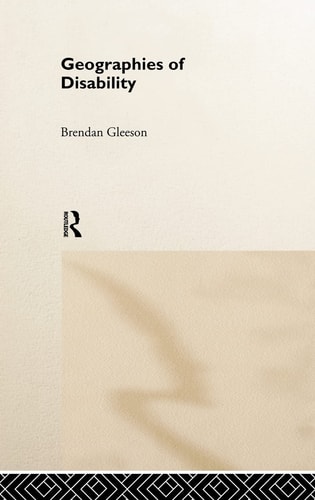
Geographies of Disability
0
0
As an Amazon Associate and affiliate partner, Menrva Books earns from qualifying purchases. Learn more
Author Description
This book explains how space, place and mobility have shaped the experiences of disabled people both in the past and in contemporary societies. The key features of this insightful study include: * a critical appraisal of theories of disability and a new disability model * case studies to explore how the transition to capitalism disadvantaged disabled people * an exploration of the Western city and the policies of community care and accessibility regulation. Brendan Gleeson presents an important contribution to the major policy debates on disability in Western societies and offers new considerations for the broader debates on embodiment and space within Geography.
Menrva's Summary
THE THESIS
This book investigates how spatial organization, urban development, and mobility constraints have historically and contemporaneously shaped the lived experiences of disabled individuals. Brendan Gleeson, a scholar in urban geography and disability studies, utilizes a critical theoretical framework to examine the intersection of physical environments and social exclusion. By analyzing the transition to capitalism and the evolution of Western urban policy, the author argues that disability is not merely a medical condition but a social construct reinforced by the built environment. The work provides a rigorous academic assessment of how policy, architecture, and economic systems dictate the inclusion or marginalization of disabled populations.
THE SCOPE MAP
What You Will Find
- A critical appraisal of existing disability theories alongside a proposed new model of disability.
- Historical analysis of how the transition to capitalism impacted the social and economic status of disabled people.
- Examination of the Western city, focusing on community care policies and accessibility regulations.
- Theoretical exploration of the relationship between human embodiment and spatial geography.
THE AUTHORITY PERSPECTIVE
Scholars and practitioners in the fields of geography and social policy frequently cite this work as a foundational text for understanding the spatial dimensions of disability. Readers often note the academic density of the prose, which provides a comprehensive and rigorous analysis of urban environments and social justice.
Page Count:
253
Publication Date:
2002-01-01
Publisher:
Taylor & Francis Group
ISBN-10:
0203021215
ISBN-13:
9780203021217
Health
History
Social policy
urban planning
People with Disabilities
Sociology
Geography