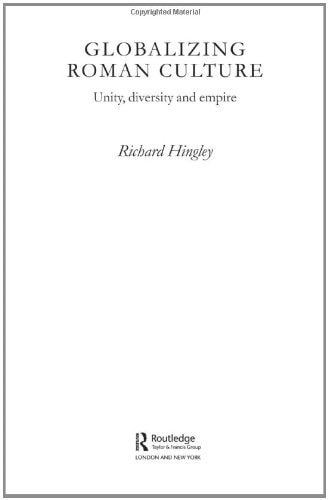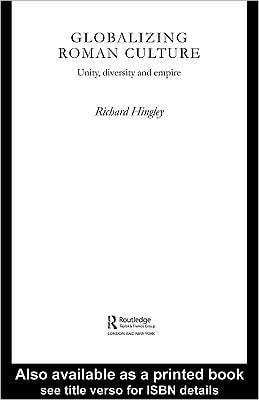
Globalizing Roman Culture: Unity, Diversity and Empire
0
0
As an Amazon Associate and affiliate partner, Menrva Books earns from qualifying purchases. Learn more
Author Description
Richard Hingley here asks the questions: What is Romanization? Was Rome the first global culture? Romanization has been represented as a simple progression from barbarism to civilization. Roman forms in architecture, coinage, language and literature came to dominate the world from Britain to Syria. Hingley argues for a more complex and nuanced view in which Roman models provided the means for provincial elites to articulate their own concerns. Inhabitants of the Roman provinces were able to develop identities they never knew they had until Rome gave them the language to express them. Hingley draws together the threads of diverse and separate study, in one sophisticated theoretical framework that spans the whole Roman Empire. Students of Rome and those with an interest in classical cultural studies will find this an invaluable mine of information.
Menrva's Summary
THE THESIS
This book investigates the nature of Romanization and whether the Roman Empire functioned as the first global culture. Richard Hingley, a specialist in Roman archaeology and cultural identity, challenges traditional narratives that frame Romanization as a linear transition from barbarism to civilization. He proposes a theoretical framework suggesting that Roman cultural forms served as a medium through which provincial elites could negotiate their own local identities and political concerns.
THE SCOPE MAP
What You Will Find
- Analysis of Roman architectural, linguistic, and numismatic influence across provinces from Britain to Syria.
- A theoretical framework for understanding cultural interaction and identity formation in the ancient world.
- Synthesis of diverse archaeological and historical studies regarding provincial elite agency.
- Examination of how imperial structures provided the vocabulary for local populations to define themselves.
THE AUTHORITY PERSPECTIVE
Scholars and students of classical history frequently cite this work for its sophisticated critique of traditional imperial models. It is widely regarded as a significant text for those seeking to understand the complexities of cultural globalization in the ancient Mediterranean.
Page Count:
224
Publication Date:
2005-01-01
Publisher:
Taylor & Francis Group
ISBN-10:
020302334X
ISBN-13:
9780203023341
History
Archaeology
Roman Empire
Rome
Acculturation
Community Tags
Similar Books