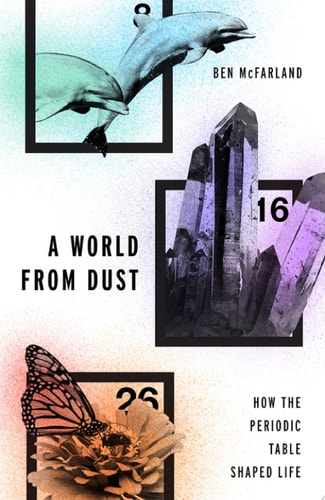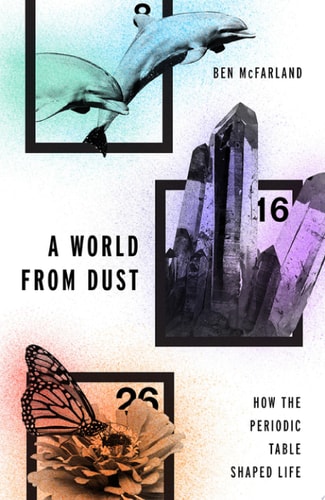
A World From Dust: How the Periodic Table Shaped Life
0
0
As an Amazon Associate and affiliate partner, Menrva Books earns from qualifying purchases. Learn more
Author Description
A World From Dust describes how a set of chemical rules combined with the principles of evolution in order to create an environment in which life as we know it could unfold. Beginning with simple mathematics, these predictable rules led to the advent of the planet itself, as well as cells, organs and organelles, ecosystems, and increasingly complex life forms. McFarland provides an accessible discussion of a geological history as well, describing how the inorganic matter on Earth underwent chemical reactions with air and water, allowing for life to emerge from the world's first rocks. He traces the history of life all the way to modern neuroscience, and shows how the bioelectric signals that make up the human brain were formed. Most popular science books on the topic present either the physics of how the universe formed, or the biology of how complex life came about; this book's approach would be novel in that it condenses in an engaging way the chemistry that links the two fields. This book is an accessible and multidisciplinary look at how life on our planet came to be, and how it continues to develop and change even today.This book includes 40 illustrations by Gala Bent, print artist and studio faculty member at Cornish College of the Arts, and Mary Anderson, medical illustrator.
Menrva's Summary
THE THESIS
How do the fundamental chemical properties of the periodic table dictate the trajectory of biological evolution and the development of complex life? Ben McFarland, a biochemist and professor, synthesizes principles from mathematics, geology, and biology to argue that life is not a series of accidents but a predictable outcome of chemical rules. He utilizes a multidisciplinary framework to connect the formation of the planet with the emergence of cellular structures and, eventually, the bioelectric complexity of the human brain.
THE SCOPE MAP
What You Will Find
- An analysis of how inorganic matter interacts with air and water to facilitate biological emergence.
- A chronological progression from atomic mathematics to the development of modern neuroscience.
- Explanations of how chemical constraints shaped the evolution of cells, organs, and ecosystems.
- Forty original illustrations by Gala Bent and Mary Anderson to visualize complex chemical and biological processes.
Scope Limits
- The text does not provide an exhaustive history of physics or cosmology, focusing instead on the chemical bridge between inorganic matter and biological life.
THE AUTHORITY PERSPECTIVE
Readers and educators frequently note that the book successfully bridges the gap between chemistry and biology, making complex scientific concepts accessible to a general audience. Experts highlight the work as a useful interdisciplinary resource for those interested in the chemical foundations of evolutionary history.
Page Count:
347
Publication Date:
2016-01-01
Publisher:
Oxford University Press
ISBN-10:
0190275030
ISBN-13:
9780190275037
Science
Popular Science
Chemistry
Evolutionary Biology
Earth Sciences
Periodic Law
Physical Chemistry
Biochemistry
Evolution
Geology
Community Tags
Similar Books