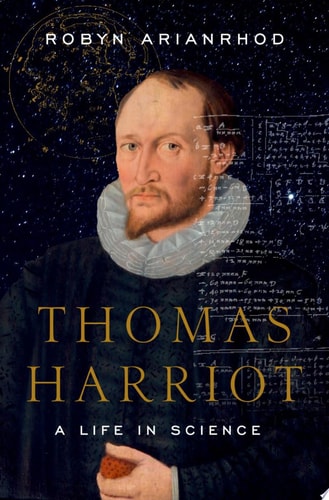
Thomas Harriot
0
0
As an Amazon Associate and affiliate partner, Menrva Books earns from qualifying purchases. Learn more
Author Description
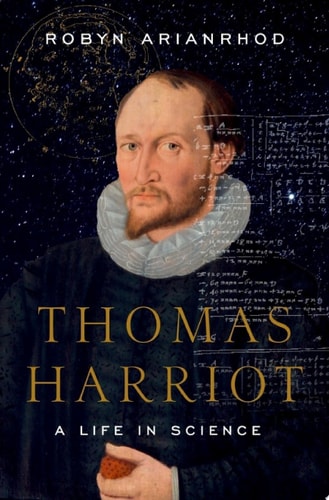
As Robyn Arianrhod shows in this new biography, the most complete to date, Thomas Harriot was a pioneer in both the figurative and literal sense. Navigational adviser and loyal friend to Sir Walter Ralegh, Harriot--whose life was almost exactly contemporaneous to Shakespeare's--took part in the first expedition to colonize Virginia in 1585. Not only was he responsible for getting Ralegh's ships safely to harbor in the New World, he was also the first European to acquire a working knowledge of an indigenous language from what is today the US, and to record in detail the local people's way of life. In addition to his navigational, linguistic, and ethnological work, Harriot was the first to use a telescope to map the moon's surface, and, independently of Galileo, recorded the behavior of sunspots and discovered the law of free fall. He preceded Newton in his discovery of the properties of the prism and the nature of the rainbow, to name just two more of his unsung firsts. Indeed many have argued that Harriot was the best mathematician of his age, and one of the finest experimental scientists of all time. Yet he has remained an elusive figure. He had no close family to pass down records, and few of his letters survive. Most importantly, he never published his scientific discoveries, and not long after his death in 1621 had all but been forgotten. In recent decades, many scholars have been intent on restoring Harriot to his rightful place in scientific history, but Arianrhod's biography is the first to pull him fully into the limelight. She has done it the only way it can be done: through his science. Using Harriot's re-discovered manuscripts, Arianrhod illuminates the full extent of his scientific and cultural achievements, expertly guiding us through what makes them original and important, and the story behind them. Harriot's papers provide unique insight into the scientific process itself. Though his thinking depended on a more natural, intuitive approach.
Menrva's Summary
THE THESIS
This biography investigates the life and scientific contributions of Thomas Harriot, a polymath whose work in navigation, mathematics, and astronomy was largely overshadowed by his contemporaries. Robyn Arianrhod, a mathematician and historian of science, utilizes Harriot's rediscovered manuscripts to reconstruct his intellectual achievements. The book argues that Harriot’s lack of formal publication and his proximity to the volatile political climate of the Elizabethan era contributed to his historical obscurity, despite his significant advancements in optics and planetary observation.
THE SCOPE MAP
What You Will Find
- Analysis of Harriot's navigational techniques used during the 1585 Virginia expedition.
- Examination of his linguistic and ethnological documentation of indigenous American cultures.
- Detailed breakdown of his independent discoveries in optics, the law of free fall, and lunar mapping.
Scope Limits
- The text does not provide a comprehensive personal or family history due to the scarcity of surviving private correspondence.
- It focuses primarily on scientific and mathematical output rather than speculative psychological analysis of Harriot’s private life.
THE AUTHORITY PERSPECTIVE
Scholars and historians of science recognize this work as a significant effort to synthesize Harriot's fragmented scientific legacy into a coherent narrative. Readers frequently note that while the prose is accessible, the technical explanations of his mathematical and optical work require a focused level of attention from the reader.
Page Count:
352
Publication Date:
2019-01-01
Publisher:
Oxford University Press
ISBN-10:
0190271868
ISBN-13:
9780190271862
Non-Fiction
Biography
Astronomy
Science History
Mathematics
Community Tags
Similar Books