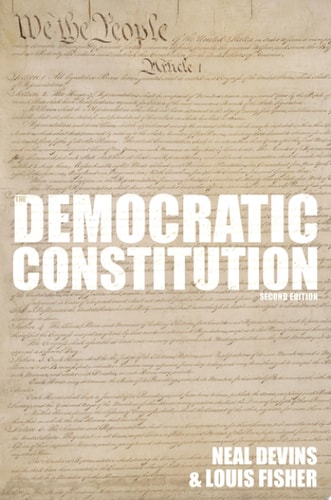
Democratic Constitution: 2nd Edition
0
0
As an Amazon Associate and affiliate partner, Menrva Books earns from qualifying purchases. Learn more
Author Description
Constitutional Law Is Clearly Shaped By Judicial Actors. But Who Else Contributes? Scholars In The Past Have Recognized That The Legislative Branch Plays A Significant Role In Determining Structural Issues, Such As Separation Of Powers And Federalism, But Stopped There--claiming That Only Courts Had The Independence And Expertise To Safeguard Individual And Minority Rights. In This Readable And Engaging Narrative, The Authors Identify The Nuts And Bolts Of The National Dialogue And Relate Succinct Examples Of How Elected Officials And The General Public Often Dominate The Supreme Court In Defining The Constitution's Meaning. Making Use Of Case Studies On Race, Privacy, Federalism, War Powers, Speech, And Religion, Devins And Fisher Demonstrate How Elected Officials Uphold Individual Rights In Such Areas As Religious Liberty And Free Speech As Well As, And Often Better Than, The Courts. This Fascinating Debunking Of Judicial Supremacy Argues That Nonjudicial Contributions To Constitutional Interpretation Make The Constitution More Stable, More Consistent With Constitutional Principles, And More Protective Of Individual And Minority Rights.-- Judicial Supremacy As Orthodoxy -- Who Participates? -- Federalism -- Separation Of Powers -- The War Power -- Privacy -- Race -- Speech -- Religion -- The Ongoing Dialogue. Neal Devins And Louis Fisher. Includes Bibliographical References And Indexes.
Menrva's Summary
THE THESIS
This book investigates the extent to which non-judicial actors, including elected officials and the general public, shape the interpretation and application of the United States Constitution. Dr. Louis Fisher and Neal Devins utilize their extensive backgrounds in constitutional law and government to challenge the doctrine of judicial supremacy. They argue that the legislative and executive branches, alongside public discourse, play a critical role in defining constitutional meaning, often providing more consistent and protective interpretations than the Supreme Court alone.
THE SCOPE MAP
What You Will Find
- Analysis of structural issues including separation of powers and federalism
- Case studies on race, privacy, war powers, speech, and religion
- Examination of the historical and practical roles of elected officials in constitutional dialogue
Scope Limits
- The text focuses primarily on the American constitutional system
- It does not provide a comprehensive legal textbook for litigation practice
THE AUTHORITY PERSPECTIVE
Experts and legal scholars recognize this work as a significant critique of judicial supremacy that provides a necessary counter-narrative to court-centric legal studies. Readers frequently note the clarity of the prose, which makes complex constitutional theory accessible to both students and the general public.
Page Count:
352
Publication Date:
2015-01-01
Publisher:
Oxford University Press, Incorporated
ISBN-10:
0190279567
ISBN-13:
9780190279561
History
United States
Law
Constitutional Law
Government
Community Tags
Similar Books