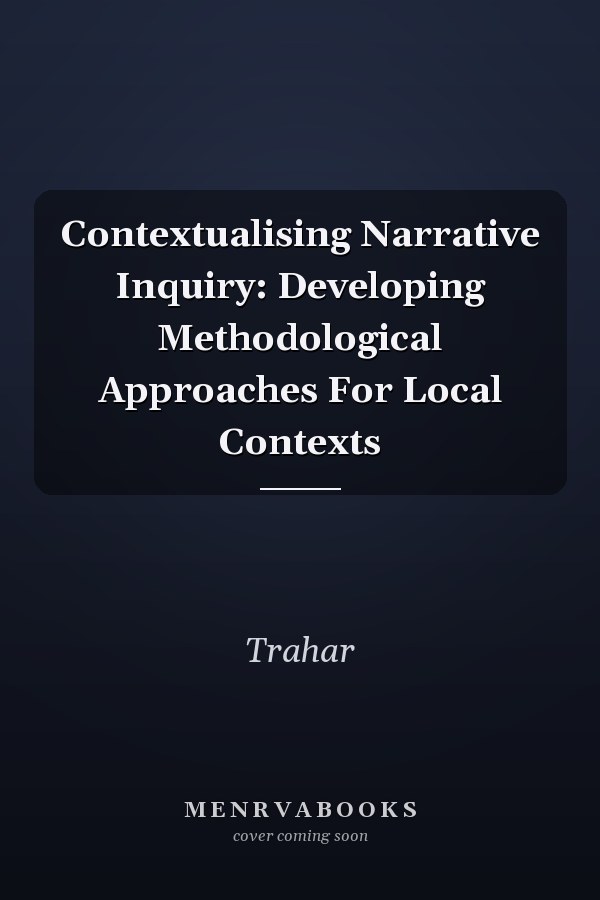
Contextualising Narrative Inquiry: Developing Methodological Approaches For Local Contexts
0
0
As an Amazon Associate and affiliate partner, Menrva Books earns from qualifying purchases. Learn more
Author Description
Narrative Inquiry Is Growing In Popularity As A Research Methodology In The Social Sciences, Medicine And The Humanities. In Narrative Inquiry, The Transparency Of Interactions Between Researcher And Research Participants, Together With Rich, Contextual Descriptions, Help To Shape And Structure Research Texts Rendering Them Engaging And Readable. Contextualising Narrative Inquiry Argues That All Researchers Should Foreground The Importance Of The Context In Which Research Takes Place And Develop Methodological Approaches That Are Grounded In Their Local Contexts. To Do So, They Need To Pay Attention To How Knowledge Is Constructed, Shared And Understood In Those Contexts. This Is Particularly Important When Contexts Have Been Subjugated Historically Through Colonialism And When Local, Indigenous Ways Of Knowing Have Been Ignored Or Dismissed. The Contributors To This Edited Collection Have All Used Narrative Inquiry For A Range Of Topics And In A Range Of Contexts, Including: Leadership Styles Of Asian Women The Deaf Community In The Uk Voluntary Celibacy In Malta Administrators In Ghanaian Higher Education Multiculturalism In Primary Education In Cyprus Teacher Identities In Hong Kong The Reflective Practitioner In Higher Education In Malaysia. The Diversity Of The Topics Illuminates The Potential For Narrative Inquiry To Be Used To Investigate A Broad Range Of Issues In Many Contexts By People With A Wide Range Of Backgrounds. A Common Thread Throughout Is A Reflexive Discussion Of How Each Contributor Used Narrative Inquiry As A Methodological Approach; Highlighting Not Only Its Affordances, But Also The Complexities Of Using It In Specific Cultural, Social And Historical Contexts.
Menrva's Summary
THE THESIS
How can researchers effectively adapt narrative inquiry methodologies to honor the specific cultural, social, and historical nuances of local contexts? Sheila Trahar and a collection of contributors argue that narrative inquiry must move beyond standardized frameworks to prioritize the unique ways knowledge is constructed and shared within diverse environments. By examining the intersection of researcher-participant interactions and local epistemologies, the text provides a critical lens for scholars working in areas historically marginalized by colonial or dominant academic structures.
THE SCOPE MAP
What You Will Find
- Methodological frameworks for adapting narrative inquiry to non-Western and localized settings.
- Reflexive analyses of researcher-participant power dynamics and transparency.
- Case studies covering diverse topics such as Asian women in leadership, deaf communities, and higher education administration in Ghana and Malaysia.
- Critical discussions on the role of indigenous ways of knowing in contemporary social science research.
THE AUTHORITY PERSPECTIVE
Experts identify this collection as a vital resource for qualitative researchers seeking to decolonize their methodological approaches. Readers frequently note the academic density of the prose, which serves as a foundational text for graduate students and practitioners engaged in cross-cultural research.
Page Count:
232
Publication Date:
2013-01-01
Publisher:
Routledge
ISBN-10:
0203071700
ISBN-13:
9780203071700
Academic
Narrative Research
Qualitative Research
Education
Community Tags
Similar Books