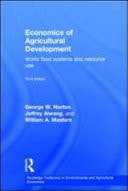
Economics of Agricultural Development
0
0
As an Amazon Associate and affiliate partner, Menrva Books earns from qualifying purchases. Learn more
Author Description
Economics Of Agricultural Development Examines The Causes, Severity, And Effects Of Poverty, Population Growth, And Malnutrition In Developing Countries. It Discusses Potential Solutions To These Problems, Progress Made In Many Countries In Recent Years, And The Implications Of Globalization For Agriculture, Poverty, And The Environment.topics Covered In The Book Include: Means For Utilizing Agricultural Surpluses To Further Overall Economic Development; The Sustainability Of The Natural Resource Environment; Gender Issues In Relation To Agriculture And Resource Use; The Contribution Of Agricultural Technologies; The Importance Of Agricultural And Macroeconomic Policies As Related To Development And Trade, And The Successes And Failures Of Such Policies; Actions To Encourage More Rapid Agricultural And Economic Developmentthe Globalization Of Trade In Goods, Services, And Capital Has Been Fundamental To Changes Being Experienced In The Agricultural And Rural Sectors Of Developing Countries. It Has Major Implications For The Fight Against Poverty And Food Insecurity And For Environmental Sustainability. Recently, Agriculture Has Returned To A Position Of Center Stage In The Development Dialog As Food Price Volatility Has Increased Along With Water Scarcity, And Concerns Grow Over The Effects Of Climate Change On Food Supply And Food Security. This New Edition Of The Essential Textbook In The Field Builds On The 2010 Edition And Reflects The Following Developments: Growth In Foreign Demand For Land And Other Natural Resources; Significant Progress In Agricultural And Economic Development In Some Low-income Countries While Others Are Being Left Behind; Continued Growth In Demand For Higher-valued Farm Productsthis Book Is Essential Reading For Undergraduate Students Seeking To Understand The Economics Of Agricultural Development And The World Food System, Including Environmental And Human Consequences, International Trade, And Capital Flows. This Book Contains A Wealth
Menrva's Summary
THE THESIS
This text investigates the complex relationship between agricultural productivity, economic growth, and the persistence of poverty and malnutrition in developing nations. The authors, Jeffrey R. Alwang, William A. Masters, and George W. Norton, utilize a blend of macroeconomic theory and empirical data to evaluate how agricultural systems function within the global economy. They present a framework that balances the necessity of technological advancement with the constraints of environmental sustainability and resource management. The book argues that agricultural development remains a primary lever for poverty reduction and food security in an increasingly volatile global market.
THE SCOPE MAP
What You Will Find
- Analysis of agricultural surpluses and their role in broader economic development.
- Examination of gender dynamics in resource use and agricultural labor.
- Evaluation of macroeconomic policies, trade liberalization, and their impact on rural sectors.
- Discussion of climate change, water scarcity, and the sustainability of natural resources.
- Assessment of foreign investment in land and the shifting demand for high-value farm products.
THE AUTHORITY PERSPECTIVE
Experts and academics recognize this work as a foundational textbook for understanding the intersection of food systems and economic policy. Readers frequently note the density of the prose and the comprehensive nature of the data, making it a standard resource for undergraduate students in development economics.
Page Count:
474
Publication Date:
2015-01-01
Publisher:
Routledge,taylor & Francis Group,
ISBN-10:
0203076214
ISBN-13:
9780203076217
Economics
International business
Business Economics
Agriculture
International Trade
Public Policy
Community Tags
Other Editions(2)

Similar Books






Reader Comments
Share Your Thoughts
No comments yet. Be the first to share your thoughts!